About the 2025 Poverty Alleviation Challenge
Poverty alleviation is a common challenge for developing countries and the entire world. In 2024, Tsinghua University, together with universities in Latin America, launched the China-Latin American Youth Responding to Global Challenges —— Poverty Alleviation Challenge, sparking a wave of university-led poverty alleviation dialogues between China and Latin America. In November of the same year, during President Xi Jinping’s visit to Brazil for the G20 Summit, Qiu Yong, Party Secretary of Tsinghua University, and the President of the Federal University of Rio de Janeiro (UFRJ) in Brazil jointly signed a university cooperation agreement on the "China-Latin American Youth Responding to Global Challenges" program. This agreement was included in the outcomes of President Xi Jinping’s visit to Brazil, becoming a landmark project led by Tsinghua University to advance win-win development between China and Latin America.
The 2025 Poverty Alleviation Challenge is co-hosted by Tsinghua University, the Federal University of Rio de Janeiro (UFRJ), the Pontifical Catholic University of Chile, the University of Chile, the University of the Pacific of Peru, Minera Las Bambas S.A.and other institutions. It has attracted the participation of more than 310 teachers and students from 27 universities and enterprises across China, Brazil, Chile and Peru.
The 2025 Poverty Alleviation Challenge consists of two stages: the Preliminary Competition and the Transnational Final. It aims to promote cross-cultural communication and collaboration, and inspire innovative thinking and practical capabilities of global youth in the field of poverty alleviation. On June 7, 2025, the Preliminary Competition of the 2025 Poverty Alleviation Challenge was successfully held, with Tsinghua University as the offline main venue and participants from Latin American countries competing simultaneously in a blended online and offline format. After fierce competition, 12 innovative teams stood out and advanced to the Transnational Final, which was held in Brazil and Chile successively in August 2025.
In January 2026, 32 Latin American university students who advanced to the final will come to China for a cultural immersion program, including face-to-face exchanges with Chinese teachers and students, visits to China’s poverty alleviation bases and institutions, and Chinese cultural tours.
The 2025 Poverty Alleviation Challenge has received support from the Chinese Embassy in Brazil, the Consulate-General of China in Rio de Janeiro, the Brazilian Embassy in China, the Chinese Embassy in Chile, the Chilean Embassy in China, and the Chinese Embassy in Peru.
We sincerely thank renowned domestic and international enterprises for their strong support for the event, including Envision Group, CGE Group of Chile, Minera Las Bambas S.A. from Peru, China Mobile International (Chile), Kuaishou International Business Unit, and Bank of Communications Brazil Branch (BOCOM BBM).
I. Introduction to the China Study Tour Week
Evolved from the competition, the China Study Tour Week is an important component of the China-Latin American Youth Responding to Global Challenges —— 2025 Poverty Alleviation Challenge. As the winning teams of this year’s Poverty Alleviation Challenge, 32 young scholars from Brazil, Chile and Peru will come to China in January 2026 to embark on a study tour themed on poverty alleviation and development, with on-site observation and in-depth exchanges at its core.
This study tour is jointly organized by the Tsinghua University Latin America Center, the Tsinghua University Rural Revitalization Work Center, and the Center for Global Competence Development of Tsinghua University Students. Through learning in real scenarios beyond the classroom, the program builds a multi-dimensional and multi-scenario dialogue platform for young people from China and Latin America, promoting mutual inspiration among different development experiences through exchanges.
II. Tour Highlights
1. Cultural Immersion in Beijing (January 18 – January 20)
The three study tour teams will arrive in Beijing on the same day and first participate in ice-breaking exchange activities, interacting face-to-face with teachers and students of Tsinghua University to establish cross-cultural connections in a relaxed and open atmosphere.
Subsequently, Latin American participants will start a three-day cultural immersion tour in the capital:
•Campus Visit: Tour Tsinghua University to experience Chinese higher education and academic atmosphere, and learn about the practical experience of Chinese universities in talent cultivation and social services.
•Exploration of History and Social Innovation: Visit the Juyongguan Great Wall and the Tsinghua University Accessibility Research Institute to understand the continuity and practical responses of China’s social development from the two dimensions of historical heritage and social innovation.
•Enterprise and Industry Exchanges: The Brazil, Chile and Peru teams will visit the headquarters of Envision Group, State Grid Corporation of China and China Minmetals Corporation respectively.
Through continuous observations in different fields and scenarios, young Latin Americans will form a more three-dimensional understanding of China’s development path and the institutional logic and practical experience behind it.
2. On-Site Research at Bases (January 21 – January 23)
After the activities in Beijing, the three study tour teams will leave the capital and go to different provinces for a three-day on-site research at the grassroots level:
•Nanjian, Yunnan (Brazil Team): Explore sustainable industrial support models based on poverty alleviation practices featuring characteristic agriculture and intangible cultural heritage (ICH), such as the public welfare project Grandma’s Chicken Soup.
•Cili, Hunan (Peru Team): Promote rural environmental improvement and development capacity building through the upgrading of characteristic agricultural products, activation of ICH, and integration of cultural tourism and education.
•Gaochun, Jiangsu (Chile Team): Build a rural revitalization demonstration of the integration of traditional handicrafts and modern design through practices such as the optimization of rural housing design, digital protection of ICH, and cultural and creative product development.
By going deep into the grassroots and communities, young Latin Americans will compare and reflect on China’s poverty alleviation experience in the context of their own development, and form cross-regional experience dialogues through exchanges.
III. Review of the 2024 Poverty Alleviation Challenge | Study and Practice in Rongjiang
In January 2025, 7 Latin American students who won the 2024 Poverty Alleviation Challenge visited Rongjiang, Guizhou, for a four-day study and practice program. During the tour, they:
•Went deep into Dong villages to experience the ICH craft of indigo dyeing.
•Participated in the Village Super League football match and competed with local youth.
•Visited ethnic characteristic homestays and learned about the practices of rural cultural tourism empowered by new media.
The practice in Rongjiang adopted a model of "taking real scenarios as classrooms and youth exchanges as links", enabling young people from China and Latin America to deeply understand the people-centered philosophy behind China’s poverty alleviation practices.
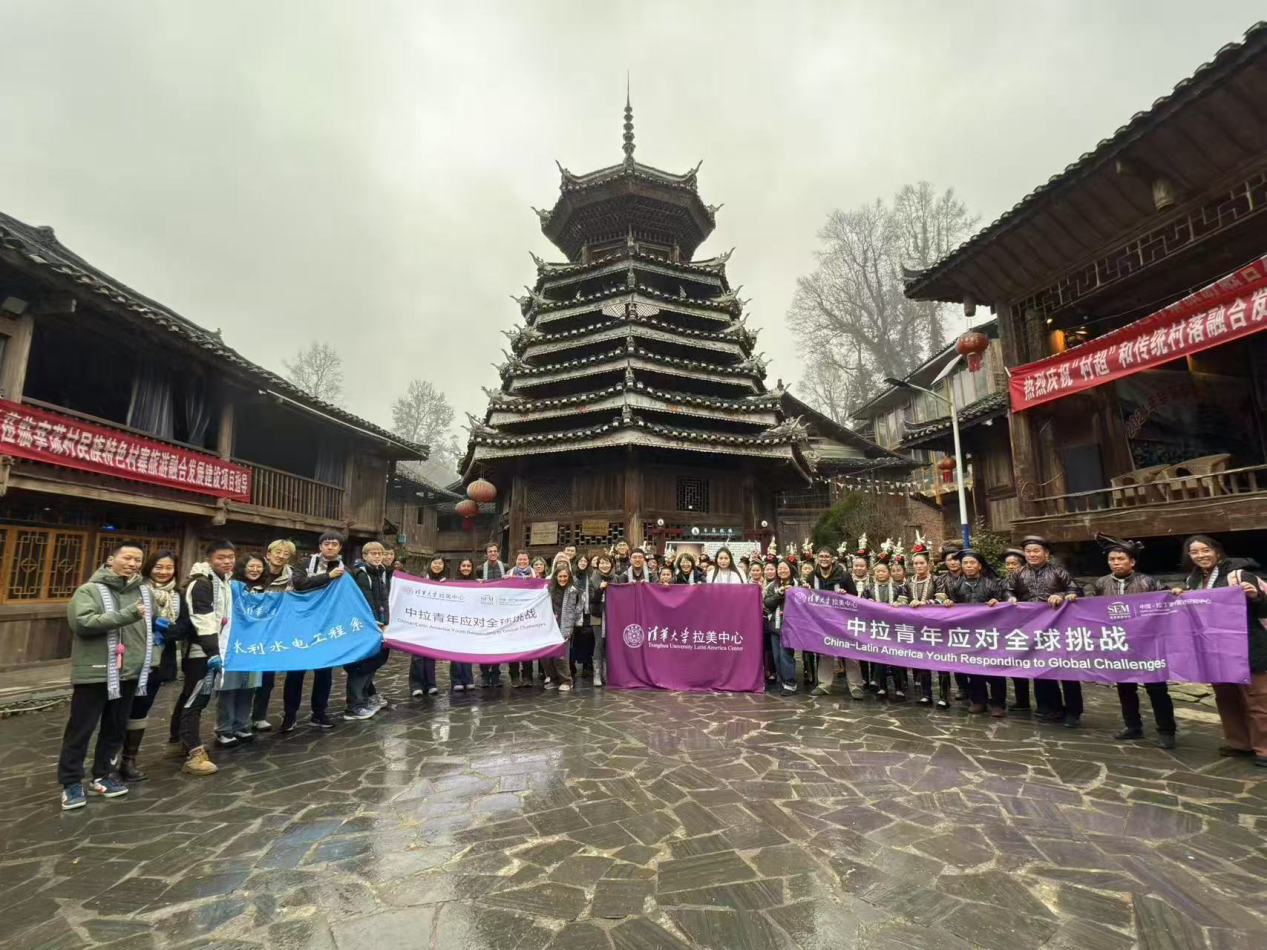
The upcoming China Study Tour Week will further expand the research areas and enrich the practical content on this basis, allowing more young Latin Americans to step into the frontlines of China’s poverty alleviation work.
IV. Ice-Breaking Exchange Meeting | Join the Poverty Alleviation Challenge Youth Network
As an important part of the China Study Tour Week, an ice-breaking exchange meeting for the Poverty Alleviation Challenge Youth Network will be specially held in the Beijing phase, open for registration to Tsinghua students interested in Latin America, global development and poverty alleviation issues.
This ice-breaking event will serve as the starting point of the Poverty Alleviation Challenge Youth Network, building a long-term collaboration platform connecting young people from China and Latin America, and running through the competition, study tour and subsequent practices. The Poverty Alleviation Challenge Youth Network aims to attract Tsinghua students with genuine willingness to participate and a strong sense of responsibility to jointly participate in the organizational support and content co-creation of youth exchanges between China and Latin America. Here, you will become a participant, supporter and co-builder in the exchange process between Chinese and Latin American youth.
What will we do together at the ice-breaking exchange meeting?
Centered on the core goal of "mutual understanding and relaxed communication", this ice-breaking exchange meeting will be held in the form of a gathering, providing a natural and open communication space for young people from China, Latin America and Tsinghua University.
The event will focus on free communication and small-group interactions. Participants can introduce their academic backgrounds, research interests, and areas of attention regarding Latin America and poverty alleviation issues, getting to know each other and establishing connections through relaxed conversations. Simple interactive and ice-breaking sessions will also be interspersed during the exchange to help students from different cultural backgrounds become familiar with each other more quickly and start communicating in a stress-free atmosphere.
Translation support, meals and refreshments will be provided on site to ensure full communication between Chinese and foreign students in a friendly and open environment.
How does the Network operate? What will you participate in?
Centered on "practical participation + clear division of labor", the Poverty Alleviation Challenge Youth Network encourages Tsinghua students to deeply integrate into the entire process of the China Study Tour:
•Study Tour Team Support: Each Latin American study tour team will be assigned 1-2 Network members who will join part of the tour to assist with communication, documentation and organizational work, including: translation and communication support, photography and video recording, tour and activity assistance, content sorting and communication co-creation, on-campus exchange and activity support, etc.
Network members will participate in the itinerary and agenda of the China Study Tour together with young Latin Americans, learning how to organize cross-cultural exchanges and support international cooperation projects in real situations, and enhancing their sense of responsibility and collaboration capabilities through practice.
What kind of participants are we looking for?
All Tsinghua students interested in Latin America, international development and poverty alleviation issues are welcome to register. Through the ice-breaking exchange meeting, Tsinghua students will have the opportunity to join the Poverty Alleviation Challenge Youth Network, maintain long-term contact with young people from China and Latin America, participate in subsequent research, practices and content co-creation, and expand their international horizons and enhance cross-cultural collaboration capabilities through real cooperation.
Welcome to add the program assistant by scanning the QR code to connect with the staff on WeChat. For the convenience of event organization and catering preparation, interested students are requested to register in advance.
The Poverty Alleviation Challenge Youth Network is not a platform for observation, but a process of joint participation, co-construction and common growth. We look forward to working with you to extend the exchanges between Chinese and Latin American youth from "encounter" to "journey together".
The 2025 Poverty Alleviation Challenge starts with an international youth competition and builds a sustainable exchange mechanism running through the competition, study tour and practices. Through the China Study Tour, young Latin Americans go deep into the frontlines of China’s poverty alleviation and rural revitalization, understand different development paths through observation, dialogue and cooperation, and enhance their ability to take action in response to global development issues. This process not only demonstrates the practical significance of China’s poverty alleviation experience, but also highlights the joint practice of young people from China and Latin America in participating in global governance and promoting sustainable development with knowledge and a sense of responsibility.