Editor's Note
Green development has become a new highlight of practical cooperation between China and Latin America. In recent years, China and Latin American countries have continued to deepen cooperation in clean energy, green infrastructure, ecological protection and other fields. A host of projects delivering economic, social and ecological benefits have been launched one after another, injecting fresh impetus into the sustainable development of both sides.
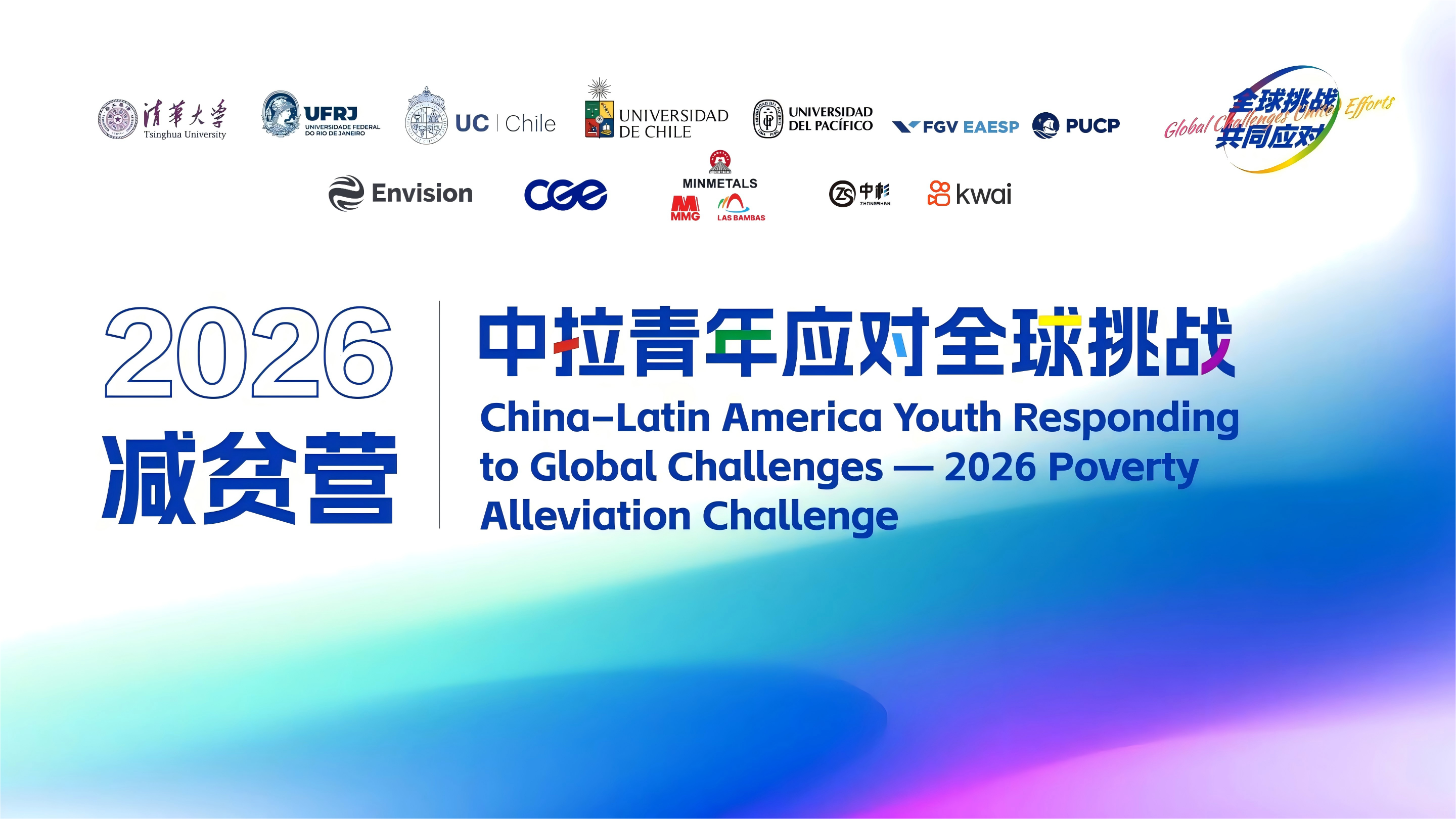
Young people from China and Latin America are also actively engaging in poverty alleviation and green development cooperation. The "China-Latin America Youth Responding to Global Challenges——2026 Poverty Alleviation Challenge" has attracted over 675 young participants from 91 universities, enterprises and institutional bodies across China, Brazil, Chile, Peru and other countries, forming a total of 120 competing teams.
Chen Taotao, Director of the Latin America Center at Tsinghua University, said that China’s technologies and development experiences not only support the construction of specific projects, but also generate sustained spillover effects through talent cultivation, industrial linkage and knowledge sharing, providing replicable and promotable cooperation paths for both sides to tackle common development challenges. Furthermore, young camp participants from Brazil, Chile and China have shared their insights into China-Latin America poverty alleviation cooperation, green transition and youth innovation based on their own observations and practical experiences, demonstrating the sense of responsibility of young people in China and Latin America in the new era to jointly advance sustainable development. This article is republished from People’s Daily Overseas Edition.
Original Article Links:
https://mk.haiwainet.cn/n/2026/BE/011E1214794275480209673.html?id=E_1214794275480209673&contentType=CT001&code=071PUi100FgsuW1HW6200NpzRa1PUi1W&state=STATE#/
https://paper.people.com.cn/rmrbhwb/pc/layout/202605/30/node_06.html
Original Title
Green Cooperation Takes Root in Latin America, All Circles in China and Latin America Full of Expectations for Bilateral Cooperation — Green Tide Surges Along the Silk Road, Joint Efforts for a Shared Future (Global Hotspot)
In Rondônia State, Brazil, the EDP power transmission and transformation project jointly constructed by Chinese enterprises and Brazilian partners runs across the tropical rainforest. (Photo by Wang Tiancong, Xinhua News Agency)
One year on from the adoption of the China-CELAC Member States Joint Action Plan for Priority Areas Cooperation (2025–2027), a steady stream of green development cooperation projects have been put into operation, further consolidating the foundation of pragmatic China-Latin America cooperation and boosting the confidence and expectations of all sectors for bilateral collaboration.
Turning Waste Green to Empower Urban Transformation
At a construction site on the outskirts of Barueri in São Paulo State, Brazil, a one-of-a-kind power station is under steady construction. It can dispose of domestic waste and convert waste into electric energy.
Fábio Gaspar, project planning engineer of the Barueri Waste-to-Energy Power Station, checks the construction progress on a daily basis and discusses technical details with Chinese employees, speaking with great anticipation. "São Paulo produces a huge volume of domestic waste every day. Previously, most household waste was disposed of through landfilling, which not only occupies land resources but also triggers problems including leachate pollution and greenhouse gas emissions," he said. "Waste disposal is a universal dilemma for major Latin American cities in their development, and now we have a greener solution to this problem."
As one of the first modern municipal domestic waste incineration power generation projects in Latin America, the Barueri Waste-to-Energy Power Station is now in the full-scale installation phase. According to Zhao Rentai, a technician from Shandong Electric Power Construction No.1 Company stationed at the project, upon completion and operation, the power station will process domestic waste generated by more than 740,000 local residents every year, with its annual power output capable of meeting the electricity demand of around 320,000 people.
"Chinese technologies have enabled us to turn waste into usable resources, and many of our colleagues have mastered the operation, maintenance and practical operational skills of the power station," said Fábio. He hopes that the local region can take this project as an opportunity to gradually build a systematic whole-chain system covering waste classification, collection, transportation and disposal, so as to improve the overall efficiency of waste resource utilization.
Gao Wenyong, a Brazilian scholar on China who travels frequently between China and Brazil, has observed that China-Latin America cooperation goes beyond pure commercial collaboration, covering technology transfer, financing capacity building and industrial chain integration. "From the perspective of Latin American countries, this is not only a vital investment, but also a typical practice that integrates economic development, poverty alleviation and large-scale ecological transformation," he commented.
Unified Standards Underpin Sustainable Development
"In the past, electric meters and metering systems from different manufacturers were incompatible. Calculating electricity bills and troubleshooting equipment faults required extremely complicated procedures. The unified power metering and communication standards introduced by China have enabled our electric meters and systems to achieve seamless compatibility," said Javier Muro, Marketing Manager of Peru’s Boluz Company, highlighting the far-reaching significance of this transformation.
Recently, with the technical support of Shenzhen Power Supply Bureau under China Southern Power Grid, local Peruvian enterprises have successfully established a unified power metering and communication protocol. The value of this "Chinese standard" has been fully reflected in frontline work. "The installation and subsequent operation and maintenance of smart meter equipment have been greatly simplified. Local residents can enjoy more accurate electricity metering and transparent billing, while our fault response efficiency has been significantly improved," Javier Muro added.
Zhang Zhihan, Deputy Supervisor of the Inspection Department of the Power Supply Service Center of Shenzhen Power Supply Bureau, explained that the unified "common language" for power systems eliminates discrepancies in communication protocols, data transmission and security mechanisms. It is also expected to cut the deployment cost of smart power equipment and accelerate the digital transformation of the energy sector.
Professor Chen Taotao, Director of the Latin America Center at Tsinghua University, pointed out that Chinese technologies have delivered prominent spillover effects in China-Latin America cooperation. Beyond supporting project construction, technological cooperation effectively drives sound industrial competition, fosters local technical talents, and promotes the coordinated development of upstream and downstream industrial chains. "This is a gradual process, yet it provides replicable models and sustainable momentum for China and Latin American countries to jointly address global challenges and deepen future cooperation."
"Equality, mutual benefit and win-win results are the core essence of China-Latin America cooperation," Gao Wenyong stressed. In practical cooperation, projects invested and constructed by Chinese enterprises always align with the priority development needs of Latin American countries in fields such as energy, logistics and connectivity. "China and Latin American countries are poised to open a new chapter of cooperation, shifting focus from traditional commodity trade to in-depth collaboration in innovation and sustainable development."
Pooling Joint Efforts to Build a Brighter Future
"We aim to build an AI model to realize fair matching between immigrants and job opportunities in Chile", "We plan to design a sustainable livelihood development path for communities around the Bambas mining area in Peru", "Integrating photovoltaic power generation with modern agriculture is a key approach to rural transformation"...
At the team matching session of the ""China-Latin America Youth Responding to Global Challenges——2026 Poverty Alleviation Challenge", over 100 teams from China, Brazil, Chile and Peru engaged in heated discussions, with young participants brimming with anticipation for poverty alleviation cooperation and green development.
"China has abundant advanced development experiences worthy of our learning," said Thomas Victor, a student from the Federal University of Rio de Janeiro, Brazil. "By adapting and applying China’s practical strategies, including professional technical assistance, integrated development of technology and traditional agriculture, and stable market channel construction, we can help numerous rural communities in Brazil achieve better development."
Shan Xiaohan, leader of a Chinese participating team, noted that China-Latin America cooperation is not merely about technology and capital input, but more about localized development concepts tailored to local conditions. "We hope to connect abstract financial concepts such as ecological compensation and inclusive finance with the lives of local people and land development in a more down-to-earth manner," she said.
"Differences exist in China-Latin America cooperation, which makes cross-border and multi-dimensional perspectives indispensable," Professor Chen Taotao said. "Insights from different disciplines can provide diverse solutions to practical problems. We encourage young students from China and Latin America to leverage youthful strength, gather wisdom and resources, identify real developmental challenges and propose practical solutions."
"China’s green transformation and development experience inspires us to pursue innovative development boldly," said América Piña from the University of Chile. "We have witnessed how a country eliminates absolute poverty while exploring a long-term and sustainable ecological development model." She believes that China and Latin American countries share the same development aspirations and missions to tackle global development issues. "As young generations, we should leverage shared knowledge and innovative creativity to build closer cooperative bonds."
(Reported by Chen Zihan)
People’s Daily Overseas Edition, May 30, 2026, Page 06