China-Latin America Youth Responding to Global Challenges – 2026 Poverty Alleviation Challenge
Registration Now Open
Global Challenges, Joint Responses
2026 Poverty Alleviation Challenge, We Invite You to Join the Competition!
What is "poverty"? What forms of poverty can you see around you? Do you want to use your professional expertise to address these poverty issues? Then join the China-Latin America Youth Responding to Global Challenges – 2026 Poverty Alleviation Challenge! Building on the resounding success of the first two editions, the 2026 Poverty Alleviation Challenge is set to kick off. Beyond an innovative competition, the Challenge features a wealth of enriching content including expert lectures and professional mentoring. How can Chinese and Latin American youth advance the global cause of poverty alleviation through cultural cooperation as a bond? We sincerely invite you to join us, stand side by side with like-minded partners, and jointly explore solutions to global challenges!
Here, you can explore global best practice cases, focus on the pain points of poverty, leverage your professional strengths, and propose innovative solutions. Outstanding teams will receive full funding support for round-trip travel (flights and accommodation) to visit Brazil/Chile for research and study, participate in the transnational final, and conduct cross-cultural exchanges with local innovative teams.
01 Background
Poverty alleviation is a common challenge for developing countries and the entire world. In 2024, the Tsinghua University Latin America Center, the Research Center for China-Latin America Management Studies at the Tsinghua University School of Economics and Management, and the Center for Global Competence Development at Tsinghua University, in collaboration with Latin American university partners, successfully launched and implemented the China-Latin America Youth Responding to Global Challenges – 2024 Poverty Alleviation Challenge in China (Tsinghua), Brazil and Chile, sparking a wave of university-led poverty alleviation dialogues across China and Latin America.
In November of the same year, during President Xi Jinping's state visit to Brazil for the 19th G20 Leaders' Summit, Qiu Yong, Party Secretary of Tsinghua University, and the Rector of the Federal University of Rio de Janeiro (UFRJ) in Brazil jointly signed a university cooperation agreement for the China-Latin America Youth Responding to Global Challenges project. This agreement was included in the outcomes of President Xi Jinping's visit to Brazil, becoming a landmark project for China-Latin America win-win development led by Tsinghua University and attracting widespread attention from all sectors in China and Latin America.
The 2025 Poverty Alleviation Challenge was co-hosted by Tsinghua University, the Federal University of Rio de Janeiro (Brazil), the Pontifical Catholic University of Chile, the University of Chile, the University of the Pacific (Peru), and institutions such as Minmetals Peru Bomboes S.A. It received support from the Embassy of the People's Republic of China in Brazil, the Consulate-General of the People's Republic of China in Rio de Janeiro, the Embassy of Brazil in China, the Embassy of the People's Republic of China in Chile, the Embassy of Chile in China, and the Embassy of the People's Republic of China in Peru. The event attracted more than 310 faculty and students from 27 universities and enterprises across four countries: China, Brazil, Chile and Peru. After fierce competition, 12 innovative teams stood out in the preliminary round and participated in the transnational finals held in Chile and Brazil in August respectively. In January 2026, 32 Latin American university students who advanced to the final came to China for cultural immersion activities, including face-to-face exchanges with Chinese faculty and students, visits to China's poverty alleviation bases and institutions, and Chinese cultural tours.
The 2026 Poverty Alleviation Challenge will further respond to the instructions of China and Latin American heads of state on promoting friendly exchanges and mutual learning between civilizations. Building on the 2025 Poverty Alleviation Challenge, it will enhance innovation efforts, integrate resources of Chinese and Latin American universities, promote project exploration and incubation, facilitate multidisciplinary cooperation, attract more high-quality participants and mentors, and empower the development and implementation of high-quality poverty alleviation outcomes.
Building on past achievements and looking to the future, the 2026 Poverty Alleviation Challenge will carry the expectations of all parties, embrace the world with a more open attitude, uphold the original aspiration of "pursuing knowledge" and "practicing", join hands with more partners, address practical challenges with concrete actions, and continuously inject new impetus into the global cause of poverty alleviation. We sincerely invite every one of you who is passionate about and concerned with poverty alleviation to take tangible actions to respond to real-world challenges and inject new energy into the global poverty alleviation cause!
02 Brief Introduction
As a sustained international youth competition, the Poverty Alleviation Challenge aims to gather efforts from multiple parties to conduct cross-cultural cooperation and practical exploration around the global poverty alleviation agenda.
1. Linkage of multiple China-Latin America divisions, and coordinated advancement of teaching, competition and research
Leveraging the university cooperation network across China, Chile, Brazil, Peru and other countries, the project has established an operational model with linked multiple divisions. With the transnational course China-Latin America Youth Responding to Global Challenges as the core carrier, it realizes the coordinated advancement of curriculum teaching, competition organization and practical research. The overall process includes stages of launch and preparation, transnational team formation, preliminary selection, transnational final and outcome summary. It organizes students from different countries to form teams, select topics jointly and conduct collaborative research through a combination of online and offline approaches.
2. Two-stage selection and two-way interactive exchange
A two-stage selection system of "Preliminary Round – Transnational Final" is implemented. Evaluation and selection are carried out in coordination with the main venue and partner universities; winning teams travel to Latin American divisions for field research and centralized presentations. Meanwhile, in the summary stage, Latin American students are invited to China for research exchanges and cultural immersion, forming a two-way interactive mechanism.
3. Integration of "Learning – Competition – Research" to drive outcome transformation
An integrated structure of "Learning – Competition – Research" is built: consolidate theoretical foundations through transnational courses and thematic lectures; strengthen problem-oriented training through field research and solution competitions; drive outcome transformation through the optimization of the "5W1H+" toolkit, case studies and project incubation. Through curriculum resource sharing, coordinated mentor guidance and cross-cultural practical exchanges, the Poverty Alleviation Challenge has gradually developed into a practical platform integrating teaching, competition and research, providing an institutionalized and sustainable training path for youth to participate in the global poverty alleviation agenda.
03 Team Formation Process
1. Principles for Transnational Team Formation
• Team size: The competition adopts a "5 + N" team structure: 5 core participants from eligible Chinese and Latin American universities/enterprises; N is optional (no more than 2 members), mainly from China-Latin America related institutions. N members are not eligible for competition evaluation or ranking but may receive a certificate of participation. It should be noted that even if a team ultimately wins the competition, the program funding will support international travel for a maximum of five core members only.
• Team nationality composition: In principle, all team members shall not be from a single country. Teams with students from China and different Latin American countries (e.g., Brazil, Chile, etc.) will receive a "Cross-cultural Bonus" in the preliminary round and the transnational final, and have the opportunity to win the "Cross-cultural Competence Award" in these stages!
2. Transnational Team Formation Process
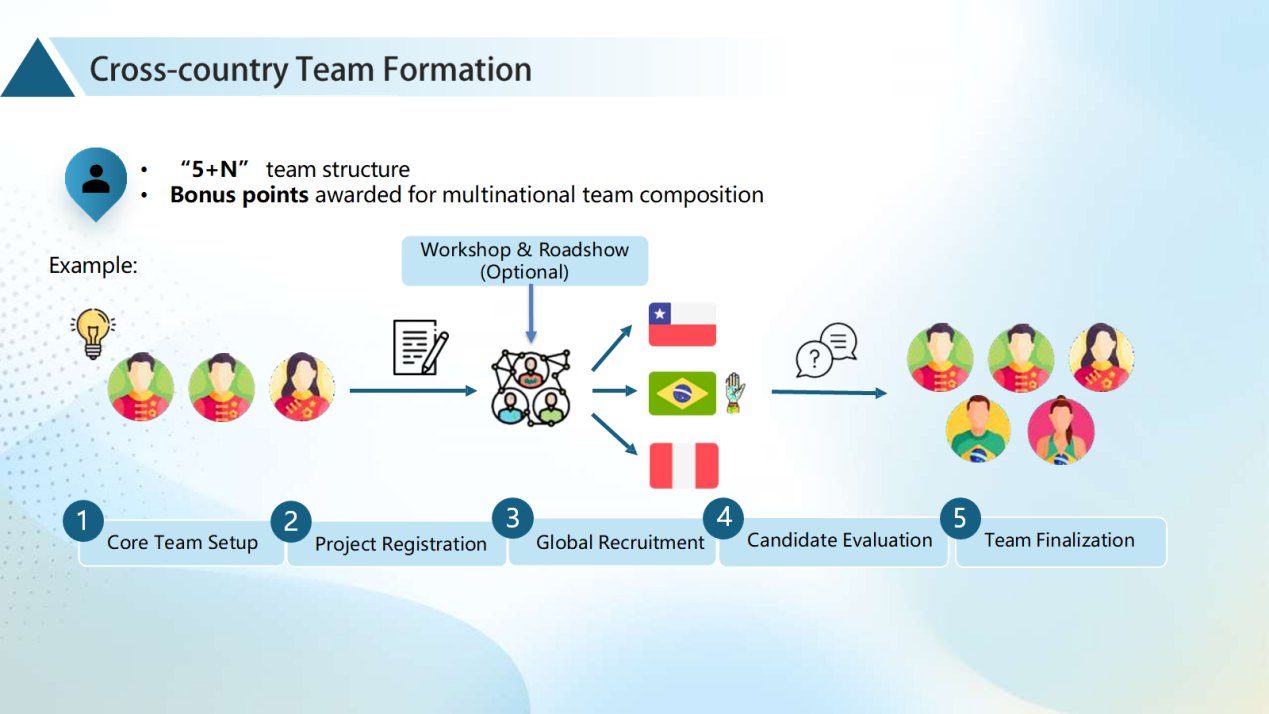
(1) Initial Team Formation and Project Roadshow
The competition features an open roadshow mechanism, encouraging teams to form and select topics as early as possible. After the initial formation of core members, if a clear research topic has been determined, teams can independently launch roadshows starting from early April, showcasing team background, research direction and recruitment needs through customized posters. The Organizing Committee will provide supporting materials (including team/individual presentation templates, roadshow recruitment guidelines and competition handbooks, etc.), systematically introducing the competition schedule, rules and requirements, tool resources, transnational team formation methods and incentive mechanisms.
For participants who have not yet determined their topics, the Organizing Committee will release official topic guidelines after April 11 as reference topics for teams to choose from and conduct roadshow recruitment. Both independently selected topics and official topics support open team formation through the roadshow mechanism.
(2) Submission of Transnational Team Formation and Topic Intent Registration Form
All teams must complete transnational team formation and submit the Transnational Team Formation and Topic Intent Registration Form to the official email of the Poverty Alleviation Challenge Organizing Committee during April 11 – May 15, 2026 (Beijing Time).
(3) Information Exchange and Online Team Formation
• Starting from April 11, 2026 (Beijing Time), teaching assistants will release shared documents based on the Transnational Team Formation and Topic Intent Registration Form, displaying existing members, recruitment needs and topic information of each team.
• Students who have not yet formed a team can view available teams through the shared documents, contact potential team members based on their own interests and strengths, or communicate through the Poverty Alleviation Challenge general group, email and other channels to join teams of interest.
• Teaching assistants will conduct topic matching among faculty and students from the participating countries and update the team formation status every Monday to improve formation efficiency.
Note: The schedule may be flexibly adjusted according to actual circumstances, and participants will be notified in advance.
(4) Public Announcement of the List of Participating Teams
• On May 15, 2026 (Beijing Time), teaching assistants will complete the final review and confirmation of transnational team formation information, ensuring that members of each team are from different countries and the team composition meets the requirements.
• The Organizing Committee will compile the complete list of participating teams and publish it on channels such as the WeChat communication group, the official website of the Tsinghua University Latin America Center, and the Poverty Alleviation Challenge competition link.
04 Incentive Mechanism
Chinese students who obtain the international research exchange incentive qualification in the 2026 Poverty Alleviation Challenge will be eligible to travel to Brazil or Chile in August 2026 for research and study and participate in the transnational final. Latin American students who receive the incentive will be eligible to travel to China in January 2027 to participate in poverty alleviation study programs. Incentives include accommodation support, international flight support, as well as incubation and implementation of high-quality projects.
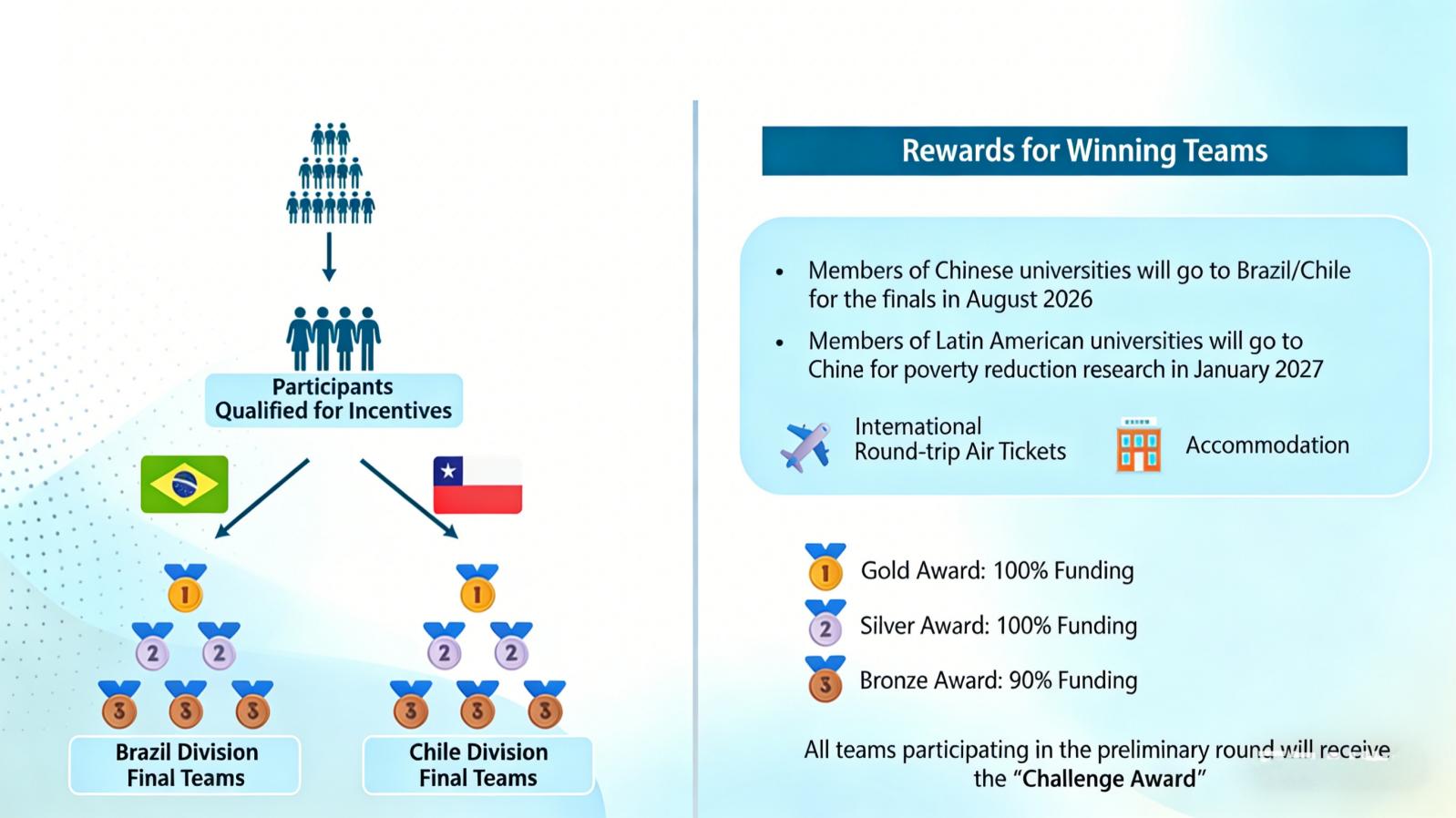
All teams will receive the "Challenge Award" in the Preliminary Round. Based primarily on the ranking of teams in the preliminary round, some participants will also obtain the incentive qualification to participate in the 2026 Poverty Alleviation Challenge Final Presentation in Brazil or Chile in August 2026 (Beijing Time) with a 70% expense reimbursement rate.
In the Transnational Final stage, on the basis of the 70% financial support from the preliminary round, the remaining 30% of the expenses will be regarded as the "International Final" Bonus, with the reimbursement rate determined by the transnational final. Winning teams can receive 100% reimbursement for accommodation and international flights.
Example: A total of 100 teams participate in the 2026 Poverty Alleviation Challenge Preliminary Round, all receiving the "Challenge Award". Among them, participants with the incentive qualification are eligible for a 70% reimbursement of the total cost of accommodation and international flights. In the transnational final stage, Gold, Silver and Bronze Award teams are selected in the Brazil and Chile divisions respectively:
• Gold and Silver Award winning teams: reimbursement of the remaining 30% of expenses, achieving 100% full reimbursement.
• Bronze Award teams and other final participants: an additional 20% reimbursement, totaling 90% expense reimbursement.
Note: The final number of winning teams may be flexibly adjusted according to actual circumstances, and participants will be notified in advance. Reimbursement shall be in accordance with the requirements of Tsinghua University.
05 Schedule
Timeline Overview of the Preliminary Round – China-Latin America Youth Responding to Global Challenges – 2026 Poverty Alleviation Challenge
1. April 1 (Wednesday): Roadshow
○ Conduct roadshows through customized posters to showcase team/individual characteristics and teammate recruitment needs, promote in-depth cross-cultural exchanges and drive transnational team formation.
2. April 11 (Saturday): Launch Briefing Session
○ All parties hold online competition briefing sessions simultaneously via ZOOM, introducing competition rules, schedule, toolkits, etc., and highlighting the transnational team formation and online mentoring mechanisms.
3. April 11 (Saturday) – May 15 (Friday): Registration, Transnational Team Formation and Topic Confirmation
○ Registration and release of pre-defined topics: While opening registration, the organizer will release a number of existing topics for teams to choose from.
○ Topic collection and team member recruitment: Individuals/teams with confirmed topics submit competition topics and basic introductions to course teaching assistants; the online topic list is updated every Monday and displayed to participants who have not yet formed teams.
○ Topic and team confirmation: All groups must confirm their topics and member composition by May 15 (Friday), concluding the team formation stage.
4. May 7 (Thursday): Poverty Alleviation Lecture I
○ Lecture by Chinese and Chilean poverty alleviation experts, held simultaneously by all parties; An In-depth Analysis of Latin America course.
5. May 14 (Thursday): Poverty Alleviation Lecture II
○ Lecture by Chinese and Brazilian poverty alleviation experts, held simultaneously by all parties; An In-depth Analysis of Latin America course.
6. May 15 (Friday): Conclusion of Team Formation Stage & Start of Mentoring Stage
7. May 16 (Saturday) – May 31 (Sunday): Online Mentoring
○ Teaching assistants collect students' questions and forward them to the mentor group, who will answer them via email or online meetings.
8. June 1 (Monday): Submission of Final Project Manuscripts
9. June 6: Holding of the Preliminary Round
○ Tsinghua University serves as the offline main venue, with students from Chile, Brazil, Peru and other countries participating online.
○ An international jury panel conducts evaluations and selects winning teams.
10. June 21 (Sunday): Release of Preliminary Round Results
06 Registration
Welcome to scan the QR code to join the group, access the registration channel directly and learn more registration information (joining one group is sufficient, no need to join repeatedly).
You can also add the official WeChat work account of the Tsinghua University Latin America Center below and leave a note with [Affiliation + Full Name]. After review and approval by the administrative staff, you will be invited to join the 2026 Poverty Alleviation Challenge competition group.

Global Challenges, Joint Responses
2026 Poverty Alleviation Challenge, We Invite You to Join the Competition!