Authors: Chen Taotao, Hong Binhan
Abstract:
The Dussel database is a specialized database for tracking China's direct investment and infrastructure projects in Latin America and the Caribbean. It is a practical resource for studying Chinese enterprises' investment and infrastructure projects in the region because the recorded investments reflect the ultimate flow of funds, ensuring authenticity and accuracy. The definition of infrastructure projects is clear, and each entry undergoes strict and meticulous verification by Professor Dussel's team.
I. Introduction to the Dussel Database
The Dussel database is a database compiled and maintained by Professor Enrique Dussel Peters of the National Autonomous University of Mexico (UNAM) and his team, designed to record China's direct investment and infrastructure projects in Latin America and the Caribbean. The database consists of two datasets: one tracks China's direct investment in Latin America, and the other tracks China's infrastructure projects in Latin America.
(I) Dussel Investment Database
As of December 2023, the Dussel Investment Database (China OFDI Monitor in Latin America and the Caribbean) records, entry by entry, China's direct investment in 27 countries across Latin America and the Caribbean from 2000 to 2022. For each investment, the database records information such as the investment year and month, the name of the investing company, the province/city of the investing company's headquarters, the name of the target company, the host country and city, the industry sector, the investment method (greenfield/M&A), the investment amount, jobs created, economic activity purpose (raw materials/manufacturing/services and local market/technology acquisition), and ownership type (public/private), among other details (see Figure 1).
[Table content omitted in translation, as it appears to be placeholder or garbled characters in the original]
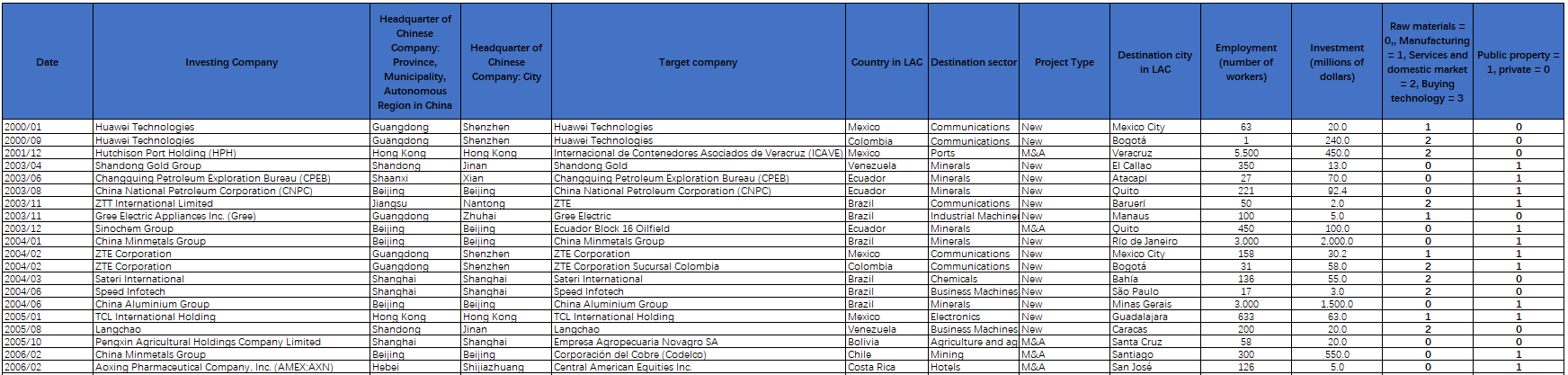
Figure 1: Overview of the Dussel Investment Database
(II) Dussel Infrastructure Projects Database
The Dussel Infrastructure Projects Database (Monitor of Chinese Infrastructure in Latin America and the Caribbean) is constructed based on the American Enterprise Institute's China Global Investment Tracker (CGIT) database, data used by Peters E.D. et al. (2018), and contributions from expert members of the Red ALC-China (the Academic Network), followed by meticulous verification. As of December 2023, this database records infrastructure projects undertaken by China in 23 countries across the LAC region from 2005 to 2021. For each infrastructure project, the database records the project start date, receiving country, specific project content, industry distribution, the Chinese supplier company (and its headquarters location) and its ownership type, transaction amount, and the total number of direct and indirect jobs created (see Figure 2).
[Table content omitted in translation, as it appears to be placeholder or garbled characters in the original]
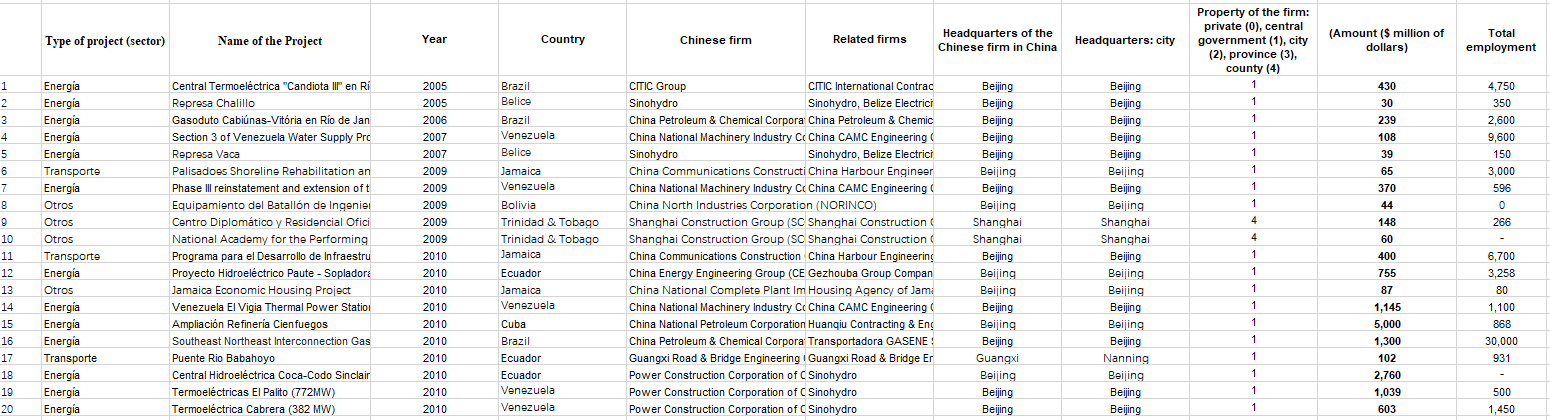
Figure 2: Overview of the Dussel Infrastructure Projects Database
II. Characteristics of the Dussel Database
(I) Records the Ultimate Flow of Funds
1.
Reflects the True Destination of Funds: The Dussel Investment Database tracks the ultimate flow of funds. This means that the destination of the funds in any Latin American or Caribbean country is the final endpoint. It includes situations where funds first flow to one or more offshore transit regions (e.g., tax havens) and are then transferred from there to the final destination. This reflects the true destination of China's OFDI. This approach is the same as that used by the American Enterprise Institute's CGIT database. In contrast, other mainstream databases, such as the Ministry of Commerce's Statistical Bulletin and the UNCTAD database, record the firstdestination of the funds.
2.
3.
Differences from Some Mainstream Databases: Because the Dussel database's methodology for tracking fund flows differs from that of some mainstream databases (e.g., the UNCTAD database), it is not possible to directly combine or compare investment amounts for the same region (Latin America and the Caribbean) between the Dussel database and other mainstream databases when researching investments from different countries.
4.
(II) Investment Records Are Authentic and Accurate
The Dussel database records implementedinvestments, with verifiable and accurate amounts (E.D. Peters, 2019). This is due to its methodological approach to data construction: First, the analyst team uses authoritative databases such as Moody's, Thomson Reuters, fDiMarkets, and CGIT as information sources to review each transaction and preliminarily determine the data scope. Second, to verify the transaction information in the database, the team cross-checks information such as the investment amount for each investment. The verification materials primarily come from the investing enterprises involved, public information sources, and commercial or professional academic institutions. If the above sources are insufficient to verify the transaction data, the team will consult secondary information sources such as trade unions and mass media for comparison and verification. The team's real-time tracking and entry-by-entry verification of professional media, corporate reports, and news from various public and private institutions and investment announcements in the LAC region mean the database can make real-time corrections to canceled or amount-changed data, ensuring the recorded investments and amounts are authentic and accurate.
(III) Clear Definition of Infrastructure Projects, Filling a Statistical Gap
E.D. Peters (2020) pointed out that there are two gaps in research on infrastructure projects by Chinese enterprises in Latin America and the Caribbean: First, existing databases lack a clear definition of infrastructure projects (e.g., CGIT). Second, there is currently no specialized statistical data on Chinese enterprises' infrastructure projects in the region.
The Dussel Infrastructure Projects Database provides a clear definition of "infrastructure projects" and highlights the key distinction from FDI. An infrastructure project refers to a situation where the client party, through bidding or direct appointment, enters into a contract with a supplier, who then provides the corresponding service to the client. The ultimate ownership of the project belongs to the client party (E.D. Peters, 2020). The key difference between an infrastructure project and FDI lies in ownership. For infrastructure projects, the project ownership belongs to the client. In FDI, the investment ownership always remains with the investing enterprise.
The Dussel Infrastructure Projects Database is based on CGIT, data used by E.D. Peters et al. (2018), and contributions from expert members of the Academic Network. The team has meticulously verified information such as the investment amount for each project. The team has removed from the database projects that were initiated but later canceled, along with their corresponding information such as amounts. For further verification, the team uses the enterprises' own information sources (including those of the client and service supplier), public information sources (Chinese embassies in the host country, business institutions, trade unions, etc.), and comparable media information sources as references. Through manual verification, its accuracy and reliability are ensured.
III. Conclusion
This paper provides a detailed introduction to the Dussel database. As a specialized database for studying Chinese enterprises' direct investment and infrastructure projects in Latin America and the Caribbean, this paper argues that the Dussel database possesses three core characteristics. First, the database records the ultimate flow of funds, which allows a significant amount of reinvestment via overseas enterprises to be traced to their final destination. However, it is important to note that due to differences in fund flow tracking methodology compared to some mainstream databases, investment amounts cannot be directly combined or compared for analysis. Second, the database records implementedinvestments with verifiable and accurate amounts. This is because the Dussel team conducts manual verification for each investment, filtering out investments that did not occur, were canceled, or have inaccurate amounts, retaining only those that have been implemented with accurate figures. Third, the Infrastructure Projects Database provides a clear and explicit definition of "infrastructure projects" and, based on this definition, collects and verifies entry-by-entry China's existing infrastructure projects in Latin America, filling a gap in existing research. Overall, the Dussel database's methodology for data collection is scientific and authentic, giving it strong reference value and practical significance for researching and understanding the real situation of Chinese enterprises' investment in Latin America.
Author Profiles:
Chen Taotao
Professor, School of Economics and Management, Tsinghua University
Director, Tsinghua University Latin America Center
Director, China-Latin America Management Research Center, School of Economics and Management, Tsinghua University
Hong Binhan
PhD Candidate, Class of 2020, Department of Finance (International Investment Direction), School of Economics and Management, Tsinghua University
Doctoral Student under the supervision of Professor Chen Taotao
References:
[1] E.D. Peters. (2019). 2019 Report on China's Direct Investment in Latin America and the Caribbean [R]. Red Académica de América Latina y el Caribe sobre China.
[2] E.D. Peters. (2020). 2020 Report on China's Infrastructure Projects in Latin America and the Caribbean [R]. Red Académica de América Latina y el Caribe sobre China.
[3] Ministry of Commerce of China. (2021). 2021 Statistical Bulletin of China's Outward Foreign Direct Investment [R].
[4] CGIT. (2021). China Global Investment Tracker [R]. American Enterprise Institute for Public Policy Research.