
Prof. Chen Taotao
Director of Tsinghua University Latin America Center
Director of Center for China-Latin America Management Studies,School of Economics and Management, Tsinghua University.
Professor of School of Economics & Management, Tsinghua University

Xin-Yu Gong
Ph.D. Candidate, Tsinghua University School of Economics and Management
Ph.D. Researcher, China-Latin America Management Research Center, Tsinghua University School of Economics and Management
In the first two articles of this series, we explored the questions of "Should enterprises assume social responsibility?" and "How to view the boundaries of corporate social responsibility?" respectively. This article continues to discuss the question of "How to understand the connotation of corporate social responsibility." Since the concept of Corporate Social Responsibility (CSR) was first formally proposed by Bowen in 1953 in his book Social Responsibilities of the Businessman, it has been like an "umbrella concept," encompassing various different ideas and philosophies (Shen Hongtao, 2006). Currently, there is no clear, unified definition formed around this concept (McWilliams et al., 2006). Some scholars even argue that because CSR is a concept based on social construction, it cannot be universally defined (Dahlsrud, 2008). We believe that reviewing its developmental trajectory, from the types of responsibility, the objects of responsibility, the context of responsibility, to the more refined nature of responsibility, the connotation of corporate social responsibility has actually undergone a continuous process of enrichment. The following will first explain two typical framework conceptual models in CSR research. These conceptual models clarify the types of responsibility in CSR. Then, we will analyze the further refinement and deepening of its connotation from the perspective of theoretical integration, which is reflected in the clarification of the objects, context, and nature of responsibility. Finally, we will briefly summarize the topic of "the connotation of corporate social responsibility."
1. Framework Conceptual Models—Clarifying Types of Responsibility
Since the concept of CSR was formally proposed by Bowen (1953) in the 1950s, different scholars and institutions have attempted to define it, yet no clear consensus has been reached to this day. Among them, many scholars have proposed framework conceptual models for CSR from the perspective of responsibility types, making its connotation more concrete. Examples include the concentric circles model by the U.S. Committee for Economic Development (1971), Carroll's pyramid model (1979, 1991), Elkington's triple bottom line model (1997), and the three-domain model by Schwartz and Carroll (2003). Among these framework conceptual models, the concentric circles model is an earlier one, while the pyramid model is a widely popular dominant model in CSR research (Geva, 2008) and holds a certain typicality. Therefore, this article will focus on reviewing these two conceptual models.
1) Concentric Circles Model
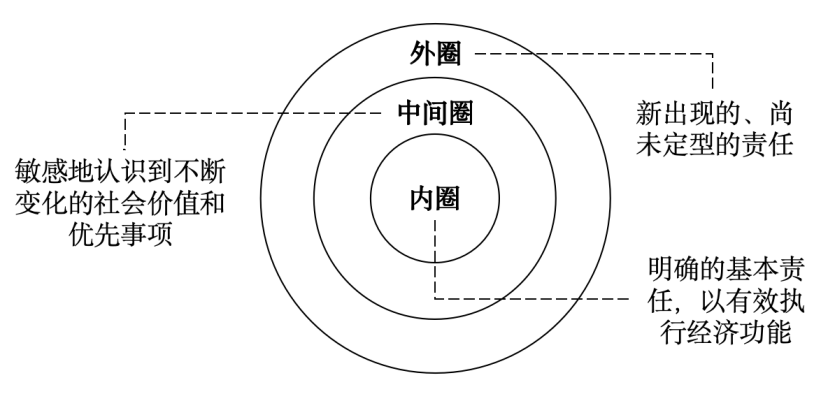
In 1971, the Committee for Economic Development (CED) in the United States published the book Social Responsibilities of Business Corporations. The book argued that the social contract between business and society is undergoing significant changes, and public expectations of business have expanded to encompass responsibilities that can be described as three concentric circles: The inner circle represents clear basic responsibilities, which is the effective execution of economic functions, such as products, employment, and economic growth. The intermediate circle includes, while fulfilling economic responsibilities, being sensitive to changing social values and priorities, such as environmental protection, employee and customer relations, etc. The outer circle outlines emerging and still undefined responsibilities that businesses should assume for their broader participation in improving the social environment, such as addressing major social problems like poverty.
It can be seen that under the concentric circles model, corporate social responsibility is divided into three types. The core is economic responsibility, which is the original raison d'être of enterprises and their foundational purpose. Expanding outward from the core circle, it reflects the enterprise's response to social values and priorities, aligning with the backdrop of the flourishing social movements in the 1960s and 1970s. The outermost circle represents emerging, undefined responsibilities, implying the "dynamic" nature that responsibilities may change with the times, involving broader social issues such as poverty. Although these social problems are not directly caused by enterprises, they can still play a key role in solving them by leveraging their resources and capabilities.
2) Pyramid Model
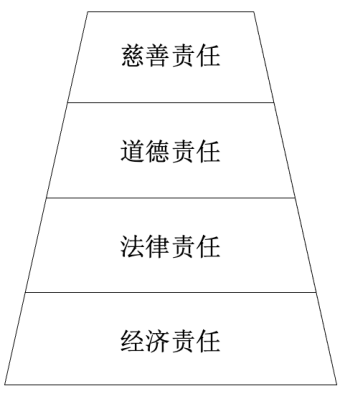
Carroll (1979) proposed a three-dimensional conceptual model of corporate social performance, in which the social responsibility dimension was further divided into four categories: economic, legal, ethical, and discretionary. This laid the foundation for Carroll's subsequent proposal of the CSR pyramid model in 1991. In 1991, Carroll re-examined his 1979 framework, renaming the "discretionary" part as "philanthropic" (Carroll, 1991), formally proposing the pyramid model of corporate social responsibility. The four parts of the model are economic, legal, ethical, and philanthropic responsibilities. Economic responsibility is the foundation for all else. Meanwhile, society expects businesses to obey the law, as law represents codified ethics, defining what is acceptable and unacceptable. Next is the firm's ethical responsibility, requiring operations in a manner consistent with expectations of societal mores and ethical norms. Finally, philanthropic responsibility is embodied as operating in a manner consistent with the philanthropic and charitable expectations of society, contributing resources to the community. In fact, the proposal of the pyramid model can find connections in earlier literature. It can be said that this classification of responsibility types actually draws on earlier definitions. For example, the division into economic, legal, and ethical responsibilities is similar to Sethi's (1975) concepts of social obligation (i.e., economic-legal responsibility) and social responsibility (i.e., discretionary ethical behavior). The philanthropic part is similar to the outermost circle of the concentric circles model. However, Carroll (1979) believed that the pyramid model's classification method is more detailed than the concentric circles model.
Source: Drawn by the author based on Carroll (1991)
Overall, the pyramid model reflects the basic roles and expectations of business in society (Carroll, 2016). The model is simple, easy to understand, and, once proposed, was widely discussed by scholars. It is the most famous CSR model (Visser, 2006), and the corresponding article has become one of the most cited in the field of business and society (Lee, 2008).
2. Application of Stakeholder Theory Clarifies the Objects of Responsibility
Although the concentric circles and pyramid models classify the basic types of corporate social responsibility, the term "social" in CSR remains vague and does not answer the question of to whom enterprises should be responsible. The emergence and application of stakeholder theory, discussed below, can help identify the specific groups or individuals that enterprises should consider in fulfilling their social responsibilities (Carroll, 1991).
Stakeholder theory gradually developed in Western countries around the 1960s, emphasizing that enterprises should serve not only shareholders but also numerous stakeholders (Jia Shenghua & Chen Honghui, 2002). Stakeholders refer to any group or individual who can affect or is affected by the achievement of the organization's objectives (Freeman, 1984). Regarding the classification of stakeholders, Freeman (1984), based on organizational boundaries, divided stakeholders into internal stakeholders (owners, customers, employees, suppliers) and external stakeholders (government, community, competitors, consumer advocates, environmentalists, special interest groups, media). Clarkson (1995) divided stakeholders into primary and secondary stakeholders. The former refers to groups without whose continuing participation the corporation cannot survive as a going concern, including shareholders and investors, customers, suppliers, employees, government, and community. The latter refers to groups that are not essential for the organization's survival. Although they have no direct transaction with the organization, they can still influence or be influenced by the organization's activities and existence, including media and a wide range of special interest groups. These classification methods have been widely accepted by other scholars subsequently. Of course, other scholars have also proposed new classification ideas from different perspectives, which are not listed here (Atkins, 1995; Henriques & Sadorsky, 1999).
In the 1980s, the increasingly popular stakeholder theory began to be applied to CSR research (Xiao Hongzhen, 2020) and has now become one of the most widely used theories in CSR research (Frynas & Yamahaki, 2016). First, stakeholder theory, to some extent, answers the question of why enterprises should fulfill social responsibilities. In the first article of this series, we argued that CSR directly stems from the social impact of enterprises; because impact is generated, responsibility for the corresponding impact is required. Stakeholder theory emphasizes that the survival and development of an enterprise should consider the interests of all stakeholders, i.e., the interests of groups affected by or affecting the enterprise (Freeman, 1984). Therefore, the two concepts are naturally aligned in philosophy. Second, stakeholder theory clarifies the objects of responsibility. Since CSR directly stems from the social impact of enterprises, and from the developmental context of the CSR concept, the specific objects of this "social impact" involve groups such as employees, consumers, and communities. These groups are precisely the stakeholders of the enterprise. Therefore, stakeholder theory also answers the question of for whom the enterprise is responsible.
Source: Drawn by the author based on Carroll (1991)
[Note: The original document contained a table listing stakeholders: Shareholders, Consumers, Employees, Community, Competitors, Suppliers, Social Activist Groups, General Public.]
In fact, many scholars in their research classify CSR practices based on stakeholder theory, following the idea of responsibility objects (Liu Chunjuan, 2013; Qi Liyun & Wei Tingting, 2013). Furthermore, some scholars have combined the idea of responsibility objects with the aforementioned idea of responsibility types. For example, Carroll (1991) integrated the pyramid model with stakeholder theory to form a two-dimensional matrix, as shown in the figure, to analyze different types of responsibilities that enterprises have towards different stakeholders in a diversified environment. Chao Gang et al. (2017) also adopted this two-dimensional analytical approach that includes both responsibility objects and types. Besides this two-dimensional analysis, Carroll (2016) also attempted to map different stakeholders to different responsibility types. He believes economic responsibility has the greatest impact on shareholders and employees; regarding legal responsibility, litigation threats for enterprises often come from employees and consumers; ethical responsibility affects all stakeholder groups, most commonly involving employees, customers, and the environment; finally, philanthropic responsibility has the greatest impact on communities and non-profit organizations. However, due to the complexity of CSR, the types of responsibility for different stakeholders in different scenarios are likely to vary. Such a general mapping paradigm may be challenging to implement in practice. For example, philanthropic responsibility to a community in one country might become a legal responsibility to the community in another. Therefore, few studies generally map different stakeholders to different responsibility types. In practice, it is still necessary to combine specific scenarios for analysis. This emphasis on context is also closely related to the application of institutional theory in CSR research, which we will discuss next.
3. Application of Institutional Theory Supplements the Context of Responsibility
Stakeholder theory clarifies the objects to whom enterprises should be responsible and, to some extent, explains why enterprises should fulfill social responsibilities. However, it still has some shortcomings in understanding reality. For example, stakeholder theory cannot help us understand why CSR differs in different contexts. For a typically socially constructed concept like CSR (Jackson & Apostolakou, 2010), we cannot discuss its connotation divorced from context. The institutional theory to be discussed below can provide useful supplementation.
Institutions are the rules of the game that constrain organizational behavior and inter-organizational relationships, including formal institutions such as legal statutes, government regulations, etc., and informal institutions such as cultural customs and moral traditions (North, 1990). Some scholars also classify institutions into regulative, normative, and cognitive institutions (Scott, 2001). Institutional theory mainly focuses on how social structures, norms, values, beliefs, and other factors influence individual and organizational behavior. As important organizations in society, enterprises naturally also find in institutional theory an analytical framework for how to adjust and adapt to the broad institutional environment in which they operate.
The real application of institutional theory to CSR research began in the mid-2000s (Schlipfenbacher, 2021). With increasing globalization and international investment activities, scholars began to explore how institutional environments shape corporate cognition and practice of social responsibility. In the second article of this series, we discussed the boundary issue of CSR. We believe that the social environment and different actors within it shape the boundaries of CSR externally, which coincides with the ideas of institutional theory. Currently, institutional theory is also one of the most widely applied theories in CSR research (Frynas & Yamahaki, 2016). Its application in CSR research mainly involves the influence of institutional contexts, such as laws, regulations, social norms, or institutional isomorphic pressures, on CSR practices (Campbell, 2006; Yang & Rivers, 2009; Jamali & Neville, 2011; Webb, 2017). For example, institutional theory emphasizes the importance of social context, helping to explain differences in CSR across different contexts (Matten & Moon, 2008; Jamali & Neville, 2011). Many scholars have compared CSR in developed and developing countries based on institutional theory (Jamali, 2014; Khojastehpour & Jamali, 2020). They argue that developed and developing countries have significant differences in their institutional environments. Developing countries are generally characterized by inadequate infrastructure, low government governance capacity, and weak regulation. Therefore, their CSR practices often focus more on solving social problems and bridging social gaps, such as education, healthcare, infrastructure, and poverty reduction. In contrast, CSR practices in developed countries focus more on environmental sustainability, consumer protection, fair trade, green marketing, and climate change issues. Therefore, institutional theory emphasizes the importance of "context" in CSR research, providing an important supplement to the context of responsibility fulfillment, thereby helping us understand the connotation of CSR in different situations.
4. Application of Other Disciplinary Perspectives Enriches the Nature of Responsibility
With the development of the times, CSR-related research has shown a more diversified trend, becoming a focus of attention in multiple disciplines such as economics, management, and political science. From different disciplinary perspectives, scholars have proposed reflections on categorizing the nature of CSR, such as Strategic CSR, Political CSR, etc.
Since the 1980s, some scholars have integrated strategic management thinking into CSR research, introducing the concept of Strategic CSR (Burke & Logsdon, 1996). This concept emphasizes that fulfilling social responsibility is not merely a passive response to negative impacts generated by the enterprise; it can also become an opportunity that the enterprise can strategically leverage to achieve dual goals of corporate economic benefits and social benefits. The proposal of Strategic CSR distinguishes socially responsible activities that have strategic meaning from purely altruistic CSR (Jamali, 2007), providing a more refined definition of the nature of responsibility. Against the backdrop of accelerating globalization in the 1990s, the rise and expansion of multinational corporations further sparked discussions among scholars in the field of business and society on topics such as the expanding role and boundaries of enterprises and the division of labor between government and business. Scholars observed enterprises increasingly participating in activities such as global regulation and public goods provision. Drawing on political theories such as Habermas's deliberative democracy theory and Rawls's theory of justice, the concept of Political CSR proposed by Scherer & Palazzo (2007) emerged. This concept also became another perspective for defining the nature of responsibility, emphasizing the role of enterprises in participating in global rule-making and providing public goods, viewing it as a new governance model in the new era.
The above concepts enrich our understanding of the connotation of CSR from the perspective of the nature of responsibility. Political CSR helps understand CSR practices in developing countries where government is absent. Strategic CSR emphasizes integrating CSR practices with the core business of the enterprise, thereby promoting corporate economic benefits while fulfilling responsibilities. Consequently, it has gradually developed into an important subfield in current CSR research.
5. Summary and Insights
As typical framework conceptual models, the concentric circles and pyramid models classify the types of corporate social responsibility, taking a significant step forward in concretizing the connotation of this concept. This provides scholars and practitioners with a handle for discussing CSR practices, enabling comparison with corporate behavior. Subsequently, the application of stakeholder theory in CSR research further clarified the objects of responsibility, helping enterprises more comprehensively identify and pay attention to their social responsibilities. The application of institutional theory emphasized the importance of the context of responsibility fulfillment, helping explain why CSR practices differ across countries and regions. Finally, research from multidisciplinary perspectives such as management and political science further contributed to defining the nature of responsibility, becoming specialized directions within the broad field of CSR research.
For enterprises, the types of responsibility mean that in the process of fulfilling social responsibilities, they not only need to make profits and comply with laws but also need to pay attention to ethical norms and social needs. The objects of responsibility, derived from stakeholder theory, mean that besides shareholders, enterprises should also pay attention to a broader range of other stakeholders such as employees, customers, government, and the community. This, to some extent, also answers the questions of why and for whom enterprises fulfill responsibilities. The context of responsibility, derived from institutional theory, emphasizes the importance of understanding the institutional environment. This, to a certain extent, determines the boundaries of CSR externally, thereby influencing its connotation. For multinational corporations investing overseas, especially in developing countries, the host country's legal system and socio-cultural atmosphere are key focuses and challenges. The stakeholders in the host country are objects that need to be identified, understood, and communicated with. Understanding the connotation of CSR in the context of the host country enables "local adaptation" in fulfilling different types of responsibilities for different stakeholders. However, due to significant differences between the home and host countries, multinational corporations newly entering a host country market often face great challenges in understanding the host country's social environment, negotiating with host country stakeholders, and implementing CSR projects. In such cases, localized methods such as hiring local personnel and partnering with local consulting agencies can help enterprises overcome these obstacles and build capacity for responsibility fulfillment. We will explore this in more depth in subsequent articles.
Main References:
[1] Burke, L., & Logsdon, J. M. (1996). How corporate social responsibility pays off. Long Range Planning, 29(4), 495–502. https://doi.org/10.1016/0024-6301(96)00041-6
[2] Campbell, J. L. (2007). Why Would Corporations Behave in Socially Responsible Ways? An Institutional Theory of Corporate Social Responsibility. The Academy of Management Review, 32(3), 946–967. https://doi.org/10.5465/amr.2007.25275684
[3] Carroll, A. B. (1979). A three-dimensional conceptual model of corporate performance. Academy of Management Review, 4(4), 497-505. https://doi.org/10.2307/257850
[4] Carroll, A. B. (1991). The Pyramid of Corporate Social Responsibility: Toward the Moral Management of Organizational Stakeholders. Business Horizons, 34(4), 39–48. https://doi.org/10.1016/0007-6813(91)90005-G
[5] Carroll, A. B. (2016). Carroll’s pyramid of CSR: Taking another look. International Journal of Corporate Social Responsibility, 1(1), 3. https://doi.org/10.1186/s40991-016-0004-6
[6] Dahlsrud, A. (2008). How corporate social responsibility is defined: An analysis of 37 definitions. Corporate Social Responsibility and Environmental Management, 15(1), 1–13. https://doi.org/10.1002/csr.132
[7] Elkington, J. (1997). The triple bottom line. Capstone Publishing.
[8] Freeman, R. E. (1984). Strategic management: A stakeholder approach(2nd ed.). Pitman.
[9] Geva, A. (2008). Three Models of Corporate Social Responsibility: Interrelationships between Theory, Research, and Practice. Business and Society Review, 113(1), 1–41. https://doi.org/10.1111/j.1467-8594.2008.00311.x
[10] Jamali, D. (2007). The Case for Strategic Corporate Social Responsibility in Developing Countries. Business and Society Review, 112(1), 1-27.
[11] Lee, M.-D. P. (2008). A review of the theories of corporate social responsibility: Its evolutionary path and the road ahead. International Journal of Management Reviews, 10(1), 53–73. https://doi.org/10.1111/j.1468-2370.2007.00226.x
[12] McWilliams, A., Siegel, D. S., & Wright, P. M. (2006). Corporate Social Responsibility: Strategic Implications. Journal of Management Studies, 43(1), 1–18. https://doi.org/10.1111/j.1467-6486.2006.00580.x
[13] Mitchell, R. K., Agle, B. R., & Wood, D. J. (1997). Toward a Theory of Stakeholder Identification and Salience: Defining the Principle of Who and What Really Counts. The Academy of Management Review, 22(4), 853–886. https://doi.org/10.2307/259247
[14] Porter, M. E., & Kramer, M. R. (2006). Strategy & Society: The Link Between Competitive Advantage and Corporate Social Responsibility. Harvard Business Review, 84(12), 78–92.
[15] Rugman, A. M., & Verbeke, A. (1998). Corporate strategies and environmental regulations: An organizing framework. Strategic Management Journal, 19(4), 363–375. https://doi.org/10.1002/(SICI)1097-0266(199804)19:4<363::AID-SMJ974>3.0.CO;2-H
[16] Scherer, A. G., & Palazzo, G. (2007). Toward a Political Conception of Corporate Responsibility: Business and Society Seen from a Habermasian Perspective. Academy of Management Review, 32(4), 1096–1120. https://doi.org/10.5465/AMR.2007.26585837
[17] Schlipfenbacher, K. M. T. (2021). The Contribution of Corporate Social Responsibility (CSR) Initiatives of Multinational Corporations (MNCs) to Social Development in a Developing Context: A Case of Rio De Janeiro, Brazil[Ph.D. dissertation, The University of Manchester (United Kingdom)].
[18] Schwartz, M. S., & Carroll, A. B. (2003). Corporate Social Responsibility: A Three-Domain Approach. Business Ethics Quarterly, 13(4), 503–530. https://doi.org/10.5840/beq200313435
[19] Sethi, S. P. (1975). Dimensions of Corporate Social Performance: An Analytical Framework. California Management Review, 17(3), 58–64. https://doi.org/10.2307/41162149
[20] Visser, W. (2006). Revisiting Carroll’s CSR Pyramid. In M. Huniche & E. P. Rahbek (Eds.), Corporate Citizenship in Developing Countries: New Partnership Perspectives(pp. 29-56). Copenhagen Business School Press.
[21] Ji, G. P., & Wang, W. X. (2022). Strategic Corporate Social Responsibility: Research Progress in the Last 25 Years and Future Research Directions. Journal of Nanchang Institute of Technology, 41(4), 88–95.
[22] Shen, H. T. (2006). The Mainstream of Corporate Social Responsibility Thought in the 21st Century: A Review of Corporate Citizenship Studies. Foreign Economics & Management, 8, 1–9. https://doi.org/10.16538/j.cnki.fem.2006.08.001