Authors: Chen Taotao et al.
Published by: Tsinghua University Press
Abstract:
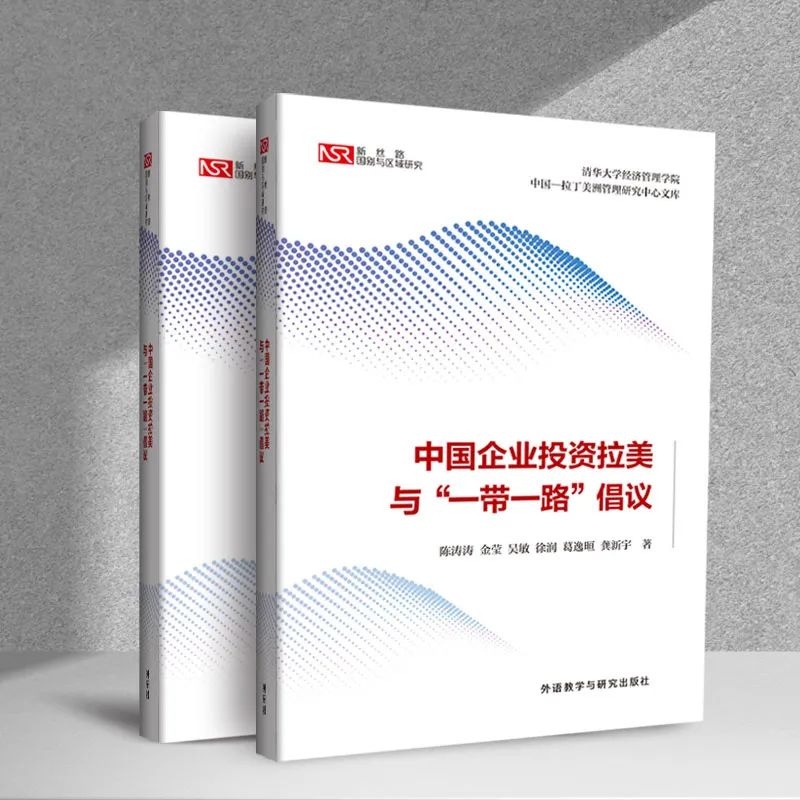
Professor Chen Taotao, Director of the Tsinghua University Latin America Center, and her team of doctoral students have published a new work titled Chinese Enterprises Investing in Latin America and the Belt and Road Initiative. The Chinese edition has been officially released, and the Spanish edition is scheduled for publication in November 2023.
Introduction:
After more than a decade of exploration in outward foreign direct investment, China proposed the Belt and Road Initiative (BRI) in 2013. In 2018, the BRI was extended to Latin America, reflecting China’s commitment to working with the world, including Latin America, to create a better future. However, transitioning from the often-questioned "outward investment" to the BRI faced skepticism and criticism in the international discourse due to institutional and cultural differences. In response to these concerns, this book integrates classical international investment theories to develop a comprehensive analytical framework for Chinese enterprises' overseas investments.
Based on this framework and the authors’ extensive fieldwork in Latin America, the book presents three in-depth case studies: Nuctech’s investment in Argentina, Joyvio’s investment in Chile, and State Grid’s investment in Brazil. These cases illustrate the capabilities of Chinese enterprises in achieving mutual benefits and fostering shared development in Latin America. Finally, in light of the doubts surrounding the extension of the BRI to Latin America, the book examines the relationship between the BRI and outward investment, addresses typical criticisms of the BRI in the global and Latin American contexts, and explores potential mechanisms for implementing the BRI in the future.
Author’s Preface:
Dear Readers,
When you open this book, I know you are already interested in its content. I imagine you may have the following questions: After extensive overseas investments by Chinese enterprises, do they possess genuine capabilities for outward investment beyond policy support? Given the vast geographical distance, can Chinese enterprises become successful and influential investors in Latin America? How are Chinese investments in Latin America related to the Belt and Road Initiative? Can BRI projects be successfully implemented locally? These are precisely the questions this book aims to answer.
Since 2004, Chinese enterprises' overseas investments have grown steadily. Starting in 2009, I led a research team on a journey to explore Chinese enterprises' overseas investments. China’s development has evolved from attracting foreign investment to outward investment and then to two-way openness. My involvement in studying this two-way openness model has given me a comprehensive and profound understanding of Chinese enterprises' growth in an open environment.
International investment theories have historically focused on multinational enterprises from developed countries. Although outward investments from developing countries have recently gained academic attention, scholars from developed countries often struggle to grasp the underlying mechanisms of developing countries' openness, while scholars from developing countries face challenges in fully understanding the realities of their enterprises' overseas investments. In China, for example, scholarly interpretations of Chinese enterprises' overseas investments remain limited. When Chinese enterprises encounter practical challenges abroad, it is difficult to find clear answers in existing theories and research.
In recent years, Chinese authorities and academia have placed greater emphasis on studying Chinese enterprises' overseas investments. The establishment of the Tsinghua University Latin America Center in 2010 provided opportunities for our research team to conduct fieldwork in Chile, Brazil, Peru, Argentina, and other countries. We engaged with Chinese investors abroad, government officials in host countries, staff of Chinese embassies, and international experts and scholars. Through theoretical research and practical investigations, we gained deeper insights into Chinese enterprises' overseas investments and the investment environments of host countries. Our analyses led to the following answers:
First, during China’s over four decades of reform and opening-up, Chinese enterprises have accumulated resources and capabilities through cooperation and competition with foreign enterprises in the domestic market. These form an important foundation for their subsequent overseas investments.
Second, the significant differences between China and other countries, particularly distant Latin American nations, pose challenges for Chinese enterprises' overseas investments. However, after years of learning and development, pioneering Chinese enterprises have become familiar with host countries' investment environments and have formulated localized strategies. As demonstrated in the case studies of Nuctech in Argentina, Joyvio in Chile, and State Grid in Brazil, these enterprises have become successful and influential investors in Latin America.
Third, the Belt and Road Initiative, grounded in extensive consultation, joint contribution, and shared benefits, is a cooperative framework aimed at building a community with a shared future for humanity. It represents an invitation from China’s contemporary leadership to the world for collaboration. In recent years, Chinese enterprises have made substantial investments in Latin America, contributing significantly to the region’s development. This demonstrates that China’s development offers opportunities for Latin America. The extension of the BRI to Latin America reflects the shared aspiration of the Chinese and Latin American peoples to build a better future. As you read this book and learn about Chinese enterprises' investment experiences in Latin America, we believe you will gain confidence in the BRI as a promising collaborative initiative.
This book also presents and elaborates on an integrated analytical framework for international investment. This framework, developed by synthesizing existing international investment theories and insights from interviews with dozens of overseas enterprises, provides the analytical lens for the three case studies.
The completion of this book is the result of the collaborative efforts of our research team, including Wu Min, Jin Ying, Xu Run, Ge Yixuan, and Gong Xinyu. Wu Min accompanied me on research trips to Argentina, Jin Ying to Chile, and Xu Run and Ge Yixuan to Brazil. The case studies of Nuctech in Argentina, Joyvio in Chile, and State Grid in Brazil are based on firsthand data collected during these field visits. Their enthusiasm, professionalism, and meticulousness in research left a profound impression on me.
This publication is supported by the Tsinghua University Latin America Center. Established in 2010 with donations from the Luksic Group of Chile, the center was formally inaugurated in Santiago, Chile, in 2018, serving as Tsinghua’s liaison and exchange hub in Latin America. We look forward to collaborating with domestic and international stakeholders to enhance this platform for exchange and cooperation, explore pathways for implementing the BRI in Latin America, and contribute to practical cooperation between China and Latin America.
Dear friends, the journey of China’s integration with Latin America and the world for mutual benefit is long. Regardless of your profession, the Tsinghua University Latin America Center is committed to working sincerely with you and accompanying you on this journey.
Chen Taotao
Professor, Department of Finance, School of Economics and Management, Tsinghua University
Director, Tsinghua University Latin America Center
Director, China-Latin America Management Research Center, School of Economics and Management, Tsinghua University
May 28, 2022

Table of Contents:
Part I: Practices of Chinese Enterprises’ Overseas Investments and Theoretical Summaries
Chapter 1: Overview, International Status, and Challenges of China’s Outward Foreign Direct Investment
Section 1: Overall Development and International Status of China’s Outward Investment
Section 2: Overall Development and Status of China’s Investment in Latin America
Section 3: Major Challenges Faced by Chinese Enterprises in Overseas Investments
Chapter 2: Review and Discussion of Classical International Investment Theories and Their Developments
Section 1: Review and Discussion of OLI Theory and Its Developments
Section 2: Review and Discussion of CAGE Theory and CCM Theory
Chapter 3: Practices of Chinese Enterprises’ Overseas Investments and the Construction of an Integrated Analytical Framework for International Investment
Section 1: Formation and Development of Chinese Enterprises’ Overseas Investment Capabilities
Section 2: Construction of the Integrated Analytical Framework for International Investment
Section 3: Interpretation of the Integrated Analytical Framework for International Investment
Part II: Investment Practices of Chinese Enterprises in Latin America
Chapter 1: Chinese Enterprises’ Investments in Argentina
Section 1: Analysis of Argentina’s Investment Environment
Section 2: Nuctech’s Investment in Argentina
Chapter 2: Chinese Enterprises’ Investments in Chile
Section 1: Chile’s Investment Environment and Economic Development Orientation
Section 2: Joyvio’s Investment in Chile
Chapter 3: Chinese Enterprises’ Investments in Brazil
Section 1: Analysis of Brazil’s Investment Environment
Section 2: State Grid’s Investment in Brazil
Part III: The Belt and Road Initiative and International Investment: Public Opinion, Responses, and Mechanism Exploration
Chapter 1: Investment Background and System Construction of the Belt and Road Initiative
Section 1: Analysis of the Investment Background of the Belt and Road Initiative
Section 2: The Belt and Road Initiative and Its System Construction
Chapter 2: Public Opinion Challenges in BRI Investment Practices and Our Responses
Section 1: Skepticism Faced by the BRI in the Global Economy and Investment Sphere
Section 2: Analysis and Responses to Related Skepticism in the Global Economy and Investment Sphere
Section 3: Skepticism Faced by the BRI in Latin American Economies and Investment Sphere and Our Responses
Section 4: Exploration of Mechanisms for Implementing BRI Projects
References