Authors: Chen Taotao, Ge Yixuan
I. Introduction of the Problem
If two countries have a close economic interdependence, are they more inclined to develop active cooperative relations, or are they more likely to effectively contain each other based on this dependency? If we go back ten years, we believe most people's answer would be the former. In an era of rapid globalization, economic interdependence between countries is precisely the result of efficient global distribution of industrial chains, with countries benefiting from their respective locational and competitive advantages, making the global economy more efficient. Moreover, in that era, people were deeply convinced of this logic. China also actively integrated into the globalization process. As the world's largest commodity trading nation and destination for foreign direct investment, and the second largest source of outward investment, China formed differentiated interdependent relationships with different global regions.
However, in recent years, "de-globalization" has frequently surfaced globally, and the China-US confrontation has gradually taken shape. After the outbreak of the China-US trade war in 2018, successive rounds of US crackdowns on China have intensified: from imposing high tariffs and cutting off chip supplies, to suppressing Chinese high-tech companies like Huawei, and attempting to isolate China by forming alliances with allies, aiming for "decoupling and severing supply chains" and limiting China's external cooperation. The effectiveness of these containment measures also depends on the economic interdependence between China and the US. Therefore, if we ask the above question today, the answer tends towards the latter.
The question itself is undoubtedly important, both theoretically and practically. After thousands of years of development in human civilization, whenever people face harsh practical problems, they turn to the crystallization of human civilization—existing theories—for answers. However, when existing theories are insufficient to explain current problems, people need to face reality and seek new answers. It is often then that existing theories gain opportunities for further development. For this reason, this paper attempts to explore how economic dependency between countries affects international economic and trade cooperation, and based on this, propose suggestions and insights for promoting the stable and healthy development of China's foreign economic cooperation.
II. Prior Research on the Impact of Economic Dependency on Inter-State Economic and Trade Cooperation
(1) The Concept of Economic Interdependence and Economic Interdependence Theory
Economic interdependence between nations has existed for a long time. From the 1950s to the 1960s, with the rapid economic growth of Europe and Japan, trade and investment between European and American countries developed rapidly, and economic interaction and connections became increasingly close. At the same time, due to the relative decline of US strength, the unilateral dependency of Western European countries and Japan on the US in the economic field began to change, leading to frequent disputes in areas like agriculture and light industry trade between the US and Europe, and the US and Japan. Faced with this series of international economic issues, Richard N. Cooper proposed the concept of "economic interdependence" in his 1968 book The Economics of Interdependence: Economic Policy in the Atlantic Community. He believed that "economic interdependence" is "the sensitive response relationship between a country's economic development and the international economy" and argued that increased interdependence between nations would bring about economic and political challenges.
Building on this, Robert O. Keohane and Joseph Nye further clarified the concept of interdependence in their book Power and Interdependence(1977), defining it as "a situation characterized by mutual effects between states or actors from different countries." Interdependence involves the relationships between nations in various fields such as politics, military, economy, and the environment. Moreover, they pointed out that dependency relationships have two important dimensions: sensitivity and vulnerability. The asymmetry in the degree of these two dimensions creates power, which in turn affects international cooperation and conflict. Interdependence can either promote increased mutual beneficial cooperation between the two sides or trigger competition and conflict, depending on the benefits and extent determined by the sensitivity and vulnerability of each actor within the dependency relationship.
(2) Prior Research on the Impact of Economic Dependency on Inter-State Economic and Trade Cooperation
Among discussions on economic dependency relationships, scholars are most concerned with whether "economic dependency between countries" contributes to peace and cooperation or leads to more conflict and even war. This paper mainly focuses on the impact of economic dependency between countries on economic and trade cooperation.
1. Positive Viewpoint: Economic Interdependence Promotes Economic Cooperation
Research on the relationship between economic and trade dependency between nations and bilateral economic cooperation mainly holds two viewpoints. One viewpoint believes that economic interdependence has a positive promoting effect on economic cooperation between countries. Baltagi et al. (2008) analyzed the link between trade dependency and direct investment in Europe, finding that as economic and trade dependency among European countries increased with the signing of Regional Trade Agreements (RTAs), more foreign direct investment took place to better provide trade services and cross-border collaboration, which was beneficial for bilateral economic cooperation. Camelia et al. (2015) expanded the research scope globally, analyzing international trade development trends from 2010 to 2014. They found that interdependence between countries became closer, which helped to further create a favorable business environment. Regarding China, Torres et al. (2018) studied bilateral trade and investments in areas like resource extraction between China and Brazil, arguing that mutual dependency exists, bilateral partnerships continue to strengthen, and both China and Brazil benefit from it. Khanindra et al. (2022) assessed the degree of economic interdependence between China and South Asian countries after the pandemic. They found that despite geopolitical considerations, economic and trade dependency between South Asian countries and China continued to increase, and bilateral trade and investment recovered rapidly after the pandemic. South Asian countries hoped to encourage free and fair competition rather than overly focus on geopolitical issues to achieve sustainable economic benefits.
Many domestic scholars also hold positive views on economic dependency. Hou Wenxia and Pang Weijie (2008) analyzed the asymmetric economic interdependence between China and ASEAN since the 21st century. They argued that as dependency deepened, the role of multinational corporations and organizations became increasingly apparent, further promoting cooperation between the two sides. Bao Jianyun (2010) empirically studied the contribution of China-Europe trade to economic growth from 1970 to 2008, explaining that economic and trade dependency contributes to bilateral economic growth, with bilateral trade becoming a driving force for international regional economic cooperation. In recent years, some domestic scholars have turned their attention beyond China. Niu Henglei and Zhang Yajun (2017) analyzed the economic interdependence and cooperation foundations and mechanisms among BRICS countries. They argued that the four countries, as emerging economies, have complementary comparative advantages and established the BRICS New Development Bank to jointly address development challenges. Hua Jiali and Pang Zhongpeng (2022) analyzed the cooperation between Japan and Saudi Arabia, centered on energy diplomacy over the years, based on the theory of complex interdependence. They found that Japan is more dependent on Saudi Arabia and has particularly strengthened multi-channel cooperation and exchanges in areas such as the royal family, political circles, industrial cooperation, and people-to-people exchanges.
2. Negative Viewpoint: Economic Interdependence Causes Economic and Trade Conflict
Another school of scholars holds the opposite view, believing that economic interdependence is a cause of economic and trade conflict. The main manifestations of international economic conflict are trade friction and economic sanctions. In research on economic and trade friction, Gartzke and Westerwinter (2016) empirically analyzed the relationship between trade dependency and conflict between countries from the 1950s to the 1990s. They found that interdependence increased economic friction between countries but also prevented conflicts from escalating into more severe militarized forms. Lee (2018) compared cases of bilateral trade friction between the US and China and the US and Japan, finding that increased bilateral economic interdependence intensified the frequency of conflict in their respective cases. It was pointed out that this increase in frequency was mainly due to the US's negative expectations about the future trade environment. Kim (2021) studied Japan's export restrictions on South Korea and South Korea's "decoupling" from Japan from a political economy perspective. It was found that Japan and South Korea have interdependence in the semiconductor field, with Japan in a position of dependency advantage. When Japan was dissatisfied with South Korea's rulings on forced labor issues, it initiated export restrictions on South Korea. This also led South Korean semiconductor companies to accelerate supply chain diversification and localization, attempting to "decouple" from Japan to reduce uncertainty.
As the degree of economic interdependence between China and the US deepened, the increasingly frequent trade frictions between China and the US became a research hotspot. Kuang Yanxiang (2010) constructed a multi-stage dynamic game model, deducing that as economic interdependence between China and the US deepens, the probability of low-level trade friction events between the two countries increases, but the probability of low-level trade friction escalating into a trade war decreases. In 2018, the Trump administration initiated and escalated the trade war with China. Li Xiaotian (2019) explored, from the perspective of economic interdependence, that because the US side had less vulnerability, it was more willing to initiate trade conflict with China and jointly implement trade protectionist policies with its allies. However, the intensity of the conflict overall remained within a controllable range. Li Wenqi and Xia Min (2021), based on comprehensive calculations considering factors like trade, investment, and economic liberalization, found that Sino-US interdependence increased from 2010 to 2017, and industrial competition between China and the US became more intense. To ensure its world leadership position, the US strengthened its containment of China to reduce dependence on Chinese production lines.
A more severe form of economic conflict than trade friction is economic sanctions, and research on this is particularly concentrated on the Russia-Ukraine issue. After the 2014 Ukraine crisis, Europe, the US, and other countries disregarded their economic and trade dependencies with Russia and adopted economic sanctions. This situation became even more pronounced after the 2022 Russia-Ukraine conflict. Loredana and Gabriela (2017) assessed the economic dependency between Russia and the EU from 2007 to 2014, finding that Russia depends on Europe in bilateral trade, energy exports, and attracting foreign investment, while Europe also has a clear dependency on Russia for energy imports. However, this bidirectional dependency did not have a significant buffering effect on the economic sanctions imposed by Europe on Russia. Silva and Selden (2020) empirically analyzed the economic sanctions of EU countries against Russia from 2013 to 2014, even finding a positive correlation between the degree of economic dependence on Russia and the severity of sanctions.
In summary, although there is abundant literature on whether economic and trade interdependence is conducive to peace and cooperation between countries, scholars' views remain divided.
III. Underlying Factors Influencing the Impact of "Economic Dependency on Inter-State Economic and Trade Cooperation"
We conducted further analysis of the existing literature on "the impact of economic dependency on inter-state economic and trade cooperation," attempting to explore the underlying factors influencing "the impact of economic dependency on inter-state economic and trade cooperation." After reviewing the periods and historical contexts of the existing literature, we found that two important factors profoundly influence the effect of bilateral dependency on international economic and trade cooperation—namely, "bilateral political relations" and "the international environment."
(1) Bilateral Political Relations Take Precedence Over Economic Dependency
In 1979, Kenneth Waltz published Theory of International Politics, pointing out that when countries face the possibility of common gains, they are more concerned with distribution, tending to strengthen independence and reduce interdependence. Political relations, compared to economic relations, belong to a higher agenda. Based on the previous analysis, we agree with Kenneth Waltz, Gao Cheng, and other scholars' views on the difference in status between political and economic relations, namely that they are not equal; there is a distinction between high and low agendas. In reality, countries with different political systems and institutional backgrounds are not lacking in multi-faceted, high-level economic cooperation. The more important influencing factor behind this is political mutual trust between nations. Good political mutual trust helps countries build a stable political environment, providing a safe development environment for enterprises' multinational operations, shielding them from turbulent politics and volatile economic conditions, reducing the uncertainty of engaging in foreign trade and investment, and promoting the smooth development of bilateral economic cooperation (Morrow, 1999; Du Yingxin, 2017; Kuang Yanxiang et al., 2017; Li Bing et al., 2022). However, when facing negative political relations such as territorial disputes, interference in internal affairs, or even military conflicts, close economic and trade activities between the two sides will inevitably encounter obstacles. Issues in "low politics" areas like economy and trade cannot effectively offset contradictions in "high politics" areas like security and military (Gao Cheng et al., 2022). This is not entirely consistent with the ideal model of complex interdependence. The recent China-US friction and the Russia-Ukraine conflict are the best examples. Whether it's China-US or Russia-Ukraine, there are extensive economic and trade links. But when facing so-called "economic security" threats or border military conflicts, a lack of political mutual trust has led the parties to adopt threatening means like economic sanctions, even triggering protracted armed conflicts.
(2) The International Environment Significantly Influences the Impact of "Economic Dependency on Bilateral Economic Cooperation"
Secondly, changes in the overall international environment affect the outcome of political factors. The interconnections between countries form the overall international political and economic landscape. Adjustments in bilateral economic and trade relations are not only influenced by the political relations between the two countries themselves but also cannot ignore the complex motives in the broader international environment.
Regarding the impact of economic and trade dependency on international economic cooperation, performance varies under different international environments. From the late 20th century to the first decade of the 21st century, after the end of the Cold War, economic globalization developed rapidly. The views of domestic and foreign scholars were relatively unified, believing that economic and trade dependency helps promote peace, reduce the intensity of conflict, and is an important force driving regional economic cooperation. During this period, even though political differences and differences in political systems still existed, peace and cooperation remained the main theme in international interactions. The utility of "using economics to stabilize politics" and even "using economics to promote politics" was evident. Taking China-US relations as an example, both sides repeatedly emphasized the need to "properly handle contradictions and differences between them, advocated for continuously expanding common interests at bilateral, regional, and international levels, and believed that close economic and trade relations between China and the US could shape stable China-US relations and avoid political confrontation."
However, this characteristic of the era changed significantly after the 2008 financial crisis, especially since 2016. Economically, after the financial crisis, developed countries such as the US and Europe experienced weak economic growth, and domestic income inequality widened, leading to the rise of "de-globalization" sentiment. Under trade protectionism, international economic and trade frictions became frequent. The US, China, the EU, and even Canada and Mexico repeatedly imposed tariff measures on each other. Politically, geopolitical interest conflicts among major powers intensified. In 2014, Russia and Western powers led by the US engaged in a "geopolitical" confrontation over influence in Ukraine, initiating multiple rounds of economic sanctions. In 2022, the Ukraine crisis erupted, and the atmosphere of confrontation between the Russian and US camps made the world increasingly fragmented. In the same year, the US launched the "Indo-Pacific Strategy" in the Indo-Pacific region to contain China, and Nancy Pelosi's unauthorized visit to China's Taiwan region severely damaged Sino-US strategic mutual trust. In this context, economic dependency has instead become a "source of conflict." The impact of trade conflicts and economic sanctions not only hinders economic cooperation between the conflicting parties but also has adverse effects on third countries within the global economic and trade network. Taking the Sino-US conflict as an example, the US constantly demands that developed European countries and vast numbers of developing countries in Latin America choose sides in international conferences and diplomatic activities, attempting to build "small circles" divided by ideological camps.
Therefore, when studying economic dependency, we should not only distinguish the political relations between countries but also not avoid or confuse the overall international environment of different periods. Only then can we better grasp the appropriate approaches and strategies for China to engage internationally with different countries in the current situation.
IV. The "Four-Quadrant" Analytical Framework for the Impact of Economic Dependency on International Economic Cooperation
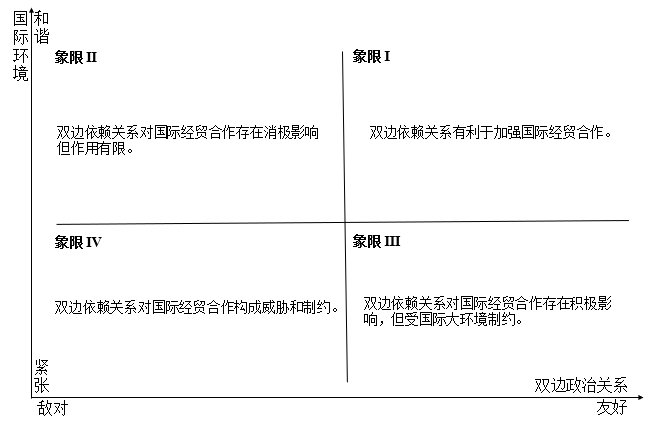
Based on changes in the international environment and political relations between countries in different periods, we further sorted the aforementioned literature on the impact of economic dependency on international economic cooperation, dividing it into four relational quadrants. In different quadrants, due to different preconditioning factors of the international environment and bilateral political relations, the role played by interdependence between countries varies. This largely explains why the conclusions in previous literature are inconsistent and is more conducive to grasping the economic impact of dependency relationships.
(1) Quadrant I: Background Conditions: Friendly Bilateral Political Relations, and a Harmonious International Environment
First, we focus on Quadrant I (the upper right part of Figure 1). This quadrant is characterized by a harmonious international environment and friendly bilateral political relations between the two countries, which constitute the main background for discussing the impact of economic dependency on bilateral economic cooperation. We believe that under the above background, the economic dependency between the two countries will inevitably play a positive role in promoting their economic cooperative relations. That is, the higher the degree of economic interdependence between the two countries, the more it will further promote the development of their economic cooperative relations (Baltagi, 2008; Camelia et al., 2015; Hou Wenxia et al., 2008; Bao Jianyun, 2010; Niu Henglei et al., 2017). As mentioned earlier, the first decade of the 21st century was in a harmonious phase of globalization. The course of economic and trade development between China and ASEAN during this period is the best example of this conclusion. On the one hand, China and ASEAN countries had established diplomatic relations before the 1990s, with no major differences in values, and bilateral political relations were friendly. On the other hand, both sides had common development aspirations and significant potential for cooperation in industrial chains. Therefore, during this period, bilateral economic and trade dependency continued to strengthen. By 2009, China had already become the largest trading partner of Malaysia and Vietnam, and the second largest trading partner of Thailand and Myanmar. At the same time, China and the ASEAN region signed a series of free trade agreements, with both sides complementing each other's advantages and deeply integrating their industrial chains. In recent years, they have become more closely connected through RCEP.
(2) Quadrant IV: Background Conditions: Hostile Bilateral Political Relations, and a Tense International Environment
Secondly, in Quadrant IV (the lower left part of Figure 1), the characteristics are completely opposite to Quadrant I. In a tense international environment, political relations between the two countries are in conflict or even hostile. In this situation, we believe that economic and trade dependency instead becomes a "source of conflict" in international economic cooperation. That is, interdependence has become a "weapon." The higher the degree of economic dependency between the two countries, the side with a lower degree of dependency can use this dependency to provoke trade friction or even impose economic sanctions on the side with a higher degree of dependency, thereby undermining the development trend of international economic and trade cooperation (Wang Youran, 2019; Liu Linqing et al., 2019; Silva and Selden, 2020). This conclusion is particularly typical in the trade war launched between China and the US in 2018. After the Trump administration took office, it positioned China as a "primary strategic competitor," and bilateral relations deteriorated. Despite close economic and trade exchanges between China and the US, with each being an important economic and trade partner to the other, the US still used the goods trade deficit as a reason, leveraging China's dependence on the US market, technology, and intermediate goods to impose multiple rounds of tariff sanctions. It also reviewed and restricted Chinese companies in the US on national security grounds, seriously affecting the healthy development of bilateral economic and trade relations.
(3) Quadrant II: Background Conditions: Hostile Bilateral Political Relations, but a Harmonious International Environment
Third, we return to the broader context of a harmonious international environment and focus on Quadrant II (the upper left part of Figure 1). In this quadrant, bilateral political relations between the two countries are still hostile, but the characteristic is that the international environment changes from tense to harmonious. We believe that under the above background, although the economic dependency between the two countries has a negative impact on their economic cooperation, the degree of impact is limited. That is, the higher the interdependence, although the global environment is conducive to enhancing mutual trust and strengthening cooperation, limited by long-term bilateral political conflicts, bilateral international cooperation grows weakly (Wang Maoping, 2009; Kuang Yanxiang et al., 2017; Gartzke and Westerwinter, 2016). After the dissolution of the Soviet Union, there was a brief "honeymoon period" between the US and Russia. After the 9/11 attacks, US policy towards Russia was temporarily adjusted. In 2002, the two sides signed the US-Russia Treaty on Mutual Legal Assistance in Criminal Matters to jointly combat crime and terrorism. Bilateral trade also continued to increase from 2001 to 2006. However, in 2007, the US established a missile defense system plan in Poland, which was strongly opposed by Russia. The following year, Russia launched the Russia-Georgia war, strongly countering NATO's eastward expansion led by the US. US-Russia political relations deteriorated again, and the growth rate of economic and trade relations fluctuated and slowed down. In 2009, against the backdrop of the financial crisis, the decline far exceeded the overall decline in US foreign trade. However, the international environment was relatively harmonious overall at that time. After 2010, US-Russia economic and trade exchanges recovered somewhat until the outbreak of the Ukraine crisis in 2014, which completely ended the process of improving US-Russia relations. Subsequently, the space for cooperation between the US and Russia narrowed comprehensively, making it difficult to bridge long-term strategic differences.
(4) Quadrant III: Background Conditions: Friendly Bilateral Political Relations, but a Tense International Environment
Finally, we focus on Quadrant III, the lower right part of Figure 1. Compared to Quadrant I, this quadrant still maintains the basic characteristic of friendly bilateral political relations between the two countries, but the international environment is tense and characterized by confrontation among major powers. We believe that when the international environment becomes tense and confrontation among major powers becomes more apparent, even if bilateral political relations are friendly, the positive effect of economic and trade dependency on international cooperation will be constrained. That is, the higher the economic interdependence between the two countries, it still has a promoting effect on bilateral economic cooperation, but the effect is diminished due to the international environment (Shi Peiran, 2019; Cao Ting, 2020; Urdinez et al., 2020). This conclusion aligns with the current state of economic and trade cooperation between China and Latin American countries. Both China and the US are important economic and trade partners for Latin American countries. Against the backdrop of China-US confrontation since 2018, the US has frequently expressed concerns, doubts, and even suppression regarding cooperation between China and Latin America, even publicly promoting the "China threat theory" on platforms like the Summit of the Americas. Although China and Latin America have long maintained good political relations, especially with increasingly close economic and trade exchanges in recent decades, US statements and pressure have also raised concerns and vigilance within Latin America regarding Sino-Latin American trade and investment, causing some trouble for the normal operations of Chinese enterprises in Latin America.
V. Implications of Research on the Impact of Economic Dependency on Economic and Trade Cooperation
Based on the above research findings, we can derive the following important insights:
First, economic dependency between two countries cannot directly lead to the continuous development of bilateral cooperation. This viewpoint is particularly important for China, which has developed rapidly for decades in the atmosphere of globalization. In fact, as mentioned earlier, in the long river of historical development, economic interdependence between countries has also repeatedly led to friction and even confrontation with some countries. However, the rare golden age of globalization before the 2008 financial crisis easily created the beautiful impression that "the world has entered a track of peaceful and common prosperous development." Facing the current complex global political situation and the sluggish state of the global economy after the pandemic, we must keep a clear head when developing international relations.
Second, the two underlying factors that determine the relationship between economic dependency and economic and trade cooperation are the bilateral political relationship and the global environment. Among them, "the political relationship between the two countries" is a relatively clear relationship. This, to some extent, explains the systemic challenges faced by China's economic development and security after the Sino-US trade friction, as the global geopolitical situation deteriorated. The "international environment" contains more factors. It reminds us that when considering the economic dependency and economic and trade cooperation between two countries, we must look at the world, take global political trends and economic situations into account, and not just focus on the pure bilateral relationship. For example, in the current international environment, China-US political relations are difficult to break the ice in the long term, and the confrontation between China and the US, as two major powers, largely constitutes the current world's political atmosphere. The US promotes "nearshoring" and "friend-shoring" of manufacturing supply chains. In June 2022, at the Ninth Summit of the Americas, it launched the "Americas Partnership for Economic Prosperity" (APEP) initiative to reconfigure and consolidate economic exchanges and cooperation in the Western Hemisphere and reduce dependence on Chinese manufacturing. These actions undoubtedly increase the instability factors for China's cooperation with developing countries and regions like Latin America.
Third, even as this study explains, economic dependency between two countries cannot directly lead to the continuous development of bilateral cooperation. However, for countries friendly to China, we should still actively seize opportunities. While fully understanding and considering the vital interests of these countries in the complex international situation, we should also actively promote economic dependency to strive to drive bilateral economic and trade cooperation and development. Taking Latin America as an example, bilateral economic and trade cooperation has continued to increase rapidly since the 21st century, becoming a stabilizer for China's friendly foreign relations. Before the China-US trade war, the overall international environment was relatively mild. Cooperation between China and Latin American countries was mainly considered from a "development perspective." The continuous enhancement of bilateral economic and trade dependency helped leverage their respective comparative advantages, achieve economic and industrial complementarity, enhance political mutual trust, and continuously promote win-win development. Since 2017, the "Belt and Road" initiative proposed by China has attracted many Latin American countries to join. The "Belt and Road" has become a "new platform and new driving force" for China-Latin America cooperation. To date, 21 Latin American countries have signed Belt and Road MOUs with China, and China-Latin America trade and investment relations have further deepened. Since there are basically no political disadvantages like geopolitical conflicts between China and Latin America, in the current relatively deteriorated international environment, China should, under the consideration of dependency relationships, focus on promoting and developing economic and trade relations with Latin America, further strengthen bilateral dependency, and strive to explore opportunities and strategies for equal, mutually beneficial, and win-win development with Latin America, truly playing a positive role in "using economics to stabilize politics" and even "using economics to promote politics."
Author Profiles:
Chen Taotao
Professor, School of Economics and Management, Tsinghua University
Director, Tsinghua University Latin America Center
Director, China-Latin America Management Research Center, School of Economics and Management, Tsinghua University
Ge Yixuan
PhD Candidate, Class of 2018, Department of Finance, School of Economics and Management, Tsinghua University
PhD Candidate Researcher, China-Latin America Management Research Center, School of Economics and Management, Tsinghua University
References:
[1] Bao Jianyun. The Interdependency between China-EU Trade and Economic Growth and the Governance of Trade Protectionism [J]. Journal of International Trade, 2010(05):29-37.
[2] Cao Ting. The U.S. Factor in China's Relations with Latin American Countries [J]. Peace and Development, 2020(1): 80-96+132-133.
[3] Du Yingxin, Guo Meixin, Yu Xinding. The Impact of Interstate Political Relations on Industry Trade: An Empirical Study Based on China's Experience [J]. China Journal of Economics, 2017, 4(01):13-40.
[4] Gao Cheng, Bu Yanjun. The Limits, Space, and Efficacy of "Using Economics to Stabilize Politics" in the Rise of a Great Power—Reflection and Reconstruction of the "Economic Ballast" Theory [J]. World Economics and Politics, 2022(10):4-41+164-165.
[5] Hou Wenxia, Pang Weijie. On Interdependence and China-ASEAN Cooperation [J]. Journal of Guizhou University of Technology (Social Science Edition), 2008, 10(2):27-29.
[6] Hua Jiali, Pang Zhongpeng. Analysis of Japan-Saudi Relations from the Perspective of Complex Interdependence [J]. Journal of Luoyang Normal University, 2022, 41(10):25-29.
[7] Kuang Yanxiang, Xiang Hongjin. The Trade Destruction and Diversion Effects of International Political Conflict—An Empirical Study Based on China-Japan Relations [J]. World Economics and Politics, 2017(9):139-155+160.
[8] Kuang Yanxiang. Economic Interdependence, Exit Costs, and the Escalation of Interstate Conflict—A Theoretical Analysis Based on a Dynamic Game Model [J]. World Economics and Politics, 2010(4):123-138+159-160.
[9] Li Bing, Dong Qingling. Partnership Upgrading and Trade Interdependence with China [J]. World Economics and Politics, 2022(07):80-99+158-159.
[10] Li Wenqi, Xia Min. Research on the Impact of Asymmetric Industrial Dependence and Conflict between China and the US [J]. Global Science, Technology and Economy Outlook, 2021, 36(12):69-76.
[11] Liu Linqing, Chen Ziruo. Power Advantage, Trade Dependence, and Similarity of Foreign Policies of Other Countries—A Comparative Analysis of China and the United States [J]. Forum of World Economics & Politics, 2019(04):66-88.
[12] Niu Henglei, Zhang Yajun. A Discussion on Selective Cooperation among BRICS Countries Based on Interdependence Theory [J]. Economic Research Guide, 2017(13):177-180.
[13] Shi Peiran. Latin America under the Sino-US Trade Friction: Discoveries and Thoughts Based on Trade Data [J]. International Economics and Trade Research, 2019, 35(10):71-90.
[14] Wang Maoping. Analysis of the Sensitivity and Vulnerability of China-Japan Economic Interdependence [J]. Japanese Research, 2009(04):37-41.
[15] Wang Youran. Be Wary of the US Abusing Economic Interdependence [N]. Chinese Social Sciences Today, 2019:003.
[16] Baltagi B H, Egger P, Pfaffermayr M. Estimating regional trade agreement effects on FDI in an interdependent world [J]. Journal of Econometrics, 2008, 145(1):194-208.
[17] Cooper R N. The Economics of Interdependence: Economic Policy in the Atlantic Community [M]. Columbia University Press, 1968.
[18] Das K Ch. Economic Interdependence Since COVID-19: China and South Asia [J]. China Report, 2022, 58(2):131-151.
[19] Gartzke E, Westerwinter O. The complex structure of commercial peace contrasting trade interdependence, asymmetry, and multipolarity [J]. Journal of Peace Research, 2016, 53(3):325-343.
[20] Keohane R O, Nye J S. Power and interdependence [J]. Survival, 1973, 15(4):158-165.
[21] Kim Y-H. Interactions between Japan's “weaponized interdependence” and Korea's responses: “decoupling from Japan” vs. “decoupling from Japanese firms" [J]. International Trade, Politics and Development, 2021, 5(1):19-31.
[22] Lee Y. Economic Interdependence and Peace: a Case Comparison Between the US-China and US-Japan Trade Disputes [J]. East Asia, 2018, 35(3): 215-232.
[23] Loredana S, Gabriela P. The EU and Russia Shifting Away from the Logic of Interdependence—an Explanation through the Complex Interdependence Theory [J]. European Integration Studies, 2017, 11(1):120-137.
[24] Morrow J D. How Could Trade Affect Conflict? [J]. Journal of Peace Research, 1999, 36(4):481-489.
[25] Silva P M, Selden Z. Economic interdependence and economic sanctions: a case study of European Union sanctions on Russia [J]. Cambridge Review of International Affairs, 2020, 33(2):229-251.
[26] Torres A P. China and Latin America, from neo-colonialism to interdependence? Brazil Case [J]. Dimension empresarial, 2018, 16(1): 185-194.
[27] Urdinez F, Mouron F, Schenoni L L, De Oliveira A J. Chinese Economic Statecraft and U.S. Hegemony in Latin America: An Empirical Analysis, 2003-2014 [J]. Latin American Politics and Society, 2016, 58(4):3-30.
[28] Waltz K N. Theory of International Politics [M]. 1st edition. Long Grove, Ill: Waveland Press, 1979.
[1] On March 8, 2018, the Trump administration announced tariffs of 25% on steel and 10% on aluminum products, firing the first shot in the China-US trade war.
[2] On October 7, 2022, the Biden administration revised the Export Administration Regulations, comprehensively restricting US companies from providing high-end chips and related production equipment to China.
[3] On December 6, 2022, the US Federal Communications Commission (FCC) issued a statement, on the grounds of posing an "unacceptable risk" to US national security, prohibiting the sale of equipment in the US from five Chinese companies including Huawei, ZTE, Hikvision, Hytera, and Zhejiang Dahua Technology.
[4] In April 2022, the US government proposed establishing the "Chip 4 Alliance" (CHIP4) with South Korea, Japan, and the Taiwan region of China, attempting to exclude the Chinese mainland from the global semiconductor supply chain alliance.
[5] "Power can be seen as the ability to control outcomes, meaning that an actor can make other actors do things they would not otherwise do, and be able to bear the costs of doing so." (Power and Interdependence, 1977)
[6] On November 4, 2002, the Framework Agreement on Comprehensive Economic Co-operation between China and ASEAN was formally signed. In November 2004, January 2007, and August 2009, China and ASEAN successively signed the Agreement on Trade in Goods, Agreement on Trade in Services, and Investment Agreement of the China-ASEAN Free Trade Area. On January 1, 2010, the China-ASEAN Free Trade Area was fully established.
[7] In 2012, ASEAN initiated the Regional Comprehensive Economic Partnership (RCEP). On November 15, 2020, 10 ASEAN countries and China, Japan, South Korea, Australia, and New Zealand—15 Asia-Pacific countries in total—formally signed the agreement.