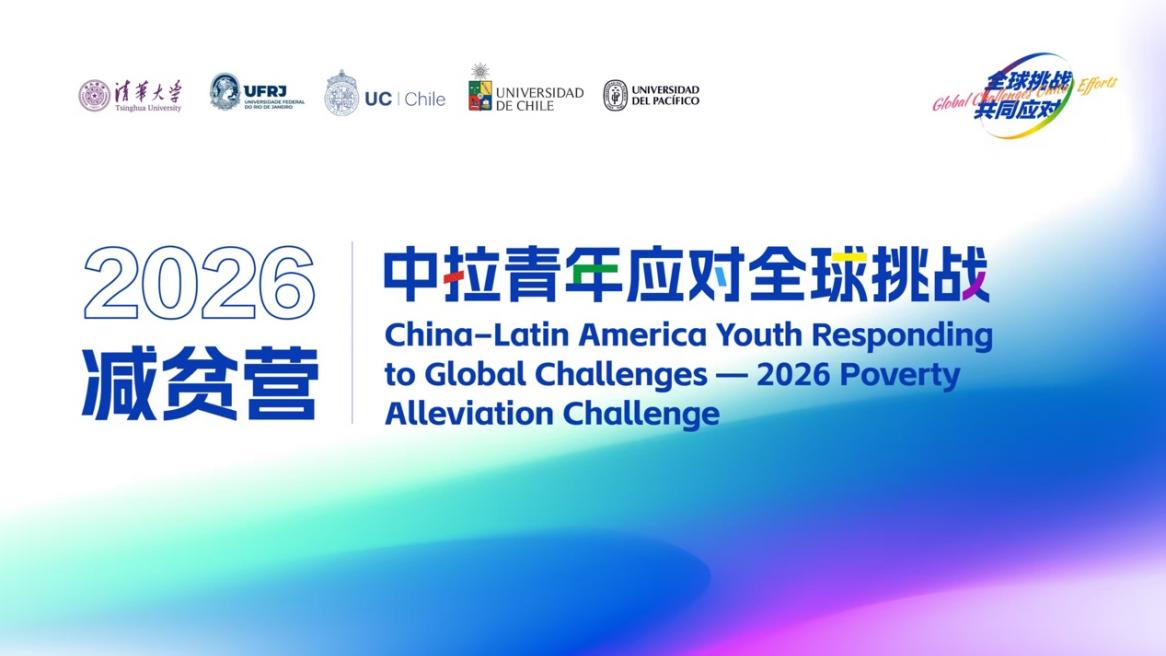
China-Latin America Youth Responding to Global Challenges
Invites you to join
2026 Poverty Alleviation Challenge Program
Discover poverty around you
Explore poverty alleviation solutions together
Outstanding teams will have the opportunity totravel to Brazil/Chile for cross-cultural mutual learning
Global challenges, respond together
About the Poverty Alleviation Challenge Program
Poverty alleviation is a common challenge for developing countries and a shared challenge for the whole world. In 2024, the Tsinghua University Latin America Center, Research Center for China-Latin America Management Studies of Tsinghua School of Economics and Management (SEM), and Center for Global Competence Development at Tsinghua University, in collaboration with Latin American university partners, launched and carried out the "China-Latin America Youth Responding to Global Challenges — 2024 Poverty Alleviation Challenge Program" in China, Brazil, and Chile, sparking a wave of university-led poverty alleviation dialogues between China and Latin America. In November of the same year, during Chinese President Xi Jinping's state visit to Brazil to attend the G20 Summit, Tsinghua University and the Federal University of Rio de Janeiro signed a cooperation agreement for this project. The agreement was included in the list of visit outcomes, becoming a landmark project for win-win development between China and Latin America. On this basis, the "2025 Poverty Alleviation Challenge Program," jointly hosted by Tsinghua University and Latin American partner institutions, attracted over 310 teachers and students from 27 universities and enterprises across four countries in China and Latin America, with 12 teams advancing to the cross-national finals held in Chile and Brazil.
The "2026 Poverty Alleviation Challenge Program" will build upon the 2025 edition with greater innovation, injecting new momentum into the global poverty alleviation cause. Through cross-national teaming, competitions, and field research, it will gather the strength of Chinese and Latin American youth to jointly explore poverty alleviation solutions. Winning teams will also have the opportunity to travel to Latin America for study and exchange. If you are eager to inject new momentum into global poverty alleviation, now is the best time to set off.
Introduction
Minera Las Bambas S.A. is one of Peru’s largest operating copper mines and a globally significant copper production base. Co-owned and jointly operated by MMG Limited, China Nonferrous International and China CITIC Metals, the project is located in the Apurímac Region. Fully commissioned for commercial operation in 2016, it boasts an ore processing capacity of 140,000 tonnes per day, serving as a major mining pillar of Peru and a critical global source of copper resources.
The company has long been committed to community development and attaches great importance to corporate social responsibility. It has made sustained investments in inclusive education, healthcare security, rural employment, ecological conservation and sustainable livelihoods, striving to drive high-quality development of local communities through industrial strengths.
This time, focusing on three core areas — digital inclusion, public health and rural livelihoods — Las Bambas officially launches six practical research propositions and opens recruitment to young people from China and Latin America. The programme will provide joint mentorship and support for real-world application scenarios, helping young innovators turn their solutions into tangible outcomes and illuminating poverty alleviation and rural development with technology and ingenuity.
Topic Introduction
Topic 1: Digital Teacher Growth Program – Enhancing Teaching Capacity for Rural Teachers
(Co-developed by Tsinghua University Online Education Center & Minera Las Bambas S.A.)
Teachers in many rural areas lack access to professional training and continuous development opportunities, with limited teaching resources and methods that affect student learning outcomes. This project aims to build a sustainable teacher professional development system by combining online courses and teacher communities.
Build an online professional development system for rural teachers, including:
· Online training courses
· A teaching case-sharing community
· Digital teaching tool training (e.g., smart classrooms)
Support: Tsinghua University Online Education Center will provide online curriculum resources, digital teaching technologies and guidance on China’ s best practices. For details of relevant mentors, please refer to the official topic announcement released by the Tsinghua University Online Education Center.
Topic 2: Offline Digital Literacy Improvement Programme for Rural Women
Design an inclusive digital literacy training model for rural women in project-affected areas. Relying on appropriate offline digital resources, enhance women’s access to education, information and economic opportunities.
Core Constraints
· Limited or no internet access
· Adaptation required to diverse cultural and social backgrounds
· Low level of basic literacy and digital skills
· Requirement for geographically targeted and community-based outreach
· Integration with formal and non-formal education systems
· Incentive and recognition mechanisms to boost participation
Expected Outcomes
· Complete digital literacy project plan (content, methodologies, implementation pathways)
· Recommendations for offline-compatible tools/platforms
· Strategies for user participation, retention and incentives
· Impact evaluation framework (literacy improvement, educational linkage, economic participation, etc.)
Topic 3: Data-Driven Decision-Making Framework for Health Interventions for Vulnerable Groups
Establish a data analysis framework to evaluate health intervention programmes for rural vulnerable groups, strengthen evidence-based decision-making, and improve the implementation efficiency of future health projects.
Core Constraints
· Diverse population groups requiring differentiated analysis
· Identification of key variables affecting health outcomes
· Weak rural data infrastructure
· Output of actionable and implementable decision recommendations
Expected Outcomes
· Structured data analysis framework (key indicators and methodologies)
· Core evaluation indicators for health intervention effectiveness
· Population classification model
· Concise reporting format for decision-makers
· Optimization recommendations for future health projects
Topic 4: Digital Post-Clinic Health Management Solution for Rural Communities
Develop digital tools to support continuous health management for rural residents after free medical clinic services, provide personalised health information, and improve treatment adherence.
Core Constraints
· Unstable internet; offline functionality required
· Mobile phones as primary devices
· Content adapted to diverse groups and health conditions
· Low health literacy in some communities
· Integration with local existing healthcare systems
Expected Outcomes
· Digital solution (APP, offline platform or hybrid model)
· User-centred functional design (health education videos, medication reminders, follow-up tracking, etc.)
· Health information classification and personalisation strategies
· Implementation and scaling roadmap
· Evaluation indicators for health outcomes and user engagement
Topic 5: Telemedicine Solution for Rural Elderly Populations
Design a telemedicine model suitable for rural elderly residents in project-affected areas, enabling convenient access to specialist medical services unavailable locally, while ensuring accessibility, trust and service continuity.
Core Constraints
· Limited rural infrastructure and internet conditions
· Low digital literacy among the elderly
· Need to build public trust in telemedicine
· Scarce specialist medical resources
· Low-cost and scalable solution requirements
Expected Outcomes
· Telemedicine service model (patient workflows, service delivery, system architecture)
· Technical solution (platform, devices or hybrid model)
· Strategies for trust building and adoption promotion among the elderly
· Integration plan with local healthcare systems
· Evaluation framework (accessibility, service quality, cost-effectiveness, satisfaction)
Topic 6: Sustainable Livelihoods Based on Community Forestry & Diversified Income Generation Models
Design implementable and replicable sustainable models to upgrade existing forestry projects into long-term community income sources, strengthen community self-governance capacity, and reduce reliance on external support.The project covers 22 communities across Cotabambas and Grau Provinces. From 2025 to 2026, it plans to cultivate over 800,000 seedlings and afforest 488 hectares, and has created temporary employment for approximately 545 community members. Currently, the project relies mainly on short-term income with insufficient sustainability; alternative livelihoods such as edible fungi cultivation have not yet formed a stable scale.
Core Constraints
· Environmental and logistics challenges in the Andean highlands
· Dependence on external funding and project-based employment
· Weak market channels and value chains
· Balance between environmental sustainability and economic viability
· Guarantee of community ownership and long-term autonomous operation
Expected Outcomes
· Integrated forestry-based sustainable income generation model (timber, non-timber forest products, carbon sinks, ecosystem services, etc.)
· Strategies to strengthen community organisation and self-governance
· Value chain development and market access plans
· Exploration of complementary livelihood models beyond forestry
· Implementation roadmap and comprehensive economic-social-environmental evaluation framework
Project Mentor

Name: Tatiana Rubio Diaz·
Current Position: Senior Specialist in Social Investment (Education)
Tatiana Rubio Díaz is an expert in the field of education. She holds a Master’s Degree in Social Investment Management from the Universidad del Pacífico (Peru) and a Master’s Degree in Early Intervention from the Complutense University of Madrid, Spain. She has over 20 years of experience in the design, management and evaluation of educational and social projects. Currently, she serves as Senior Specialist in Social Investment (Education) at Minera Las Bambas S.A.
She has provided consulting services for the International Organization for Migration (IOM), the United Nations International Children’s Emergency Fund (UNICEF), the United Nations Educational, Scientific and Cultural Organization (UNESCO) and multiple enterprises. Specialising in gender equality, child development, rural revitalisation and local economic development, she has driven the implementation of high-impact social projects. She also possesses rich practical and research experience in educational support for migrants and refugees, social protection, and innovative educational approaches.
Closing
Join Us
Address poverty alleviation challenges through innovation,and illuminate the rural future with technology.
We welcome young talents from China and Latin America to apply actively.
Let us work together to develop implementable,
replicable and scalable poverty alleviation solutions!