China-Latin America Youth Responding to Global Challenges
Invites you to join
2026 Poverty Alleviation Challenge Program
Discover poverty around you
Explore poverty alleviation solutions together
Outstanding teams will have the opportunity totravel to Brazil/Chile for cross-cultural mutual learning
Global challenges, respond together
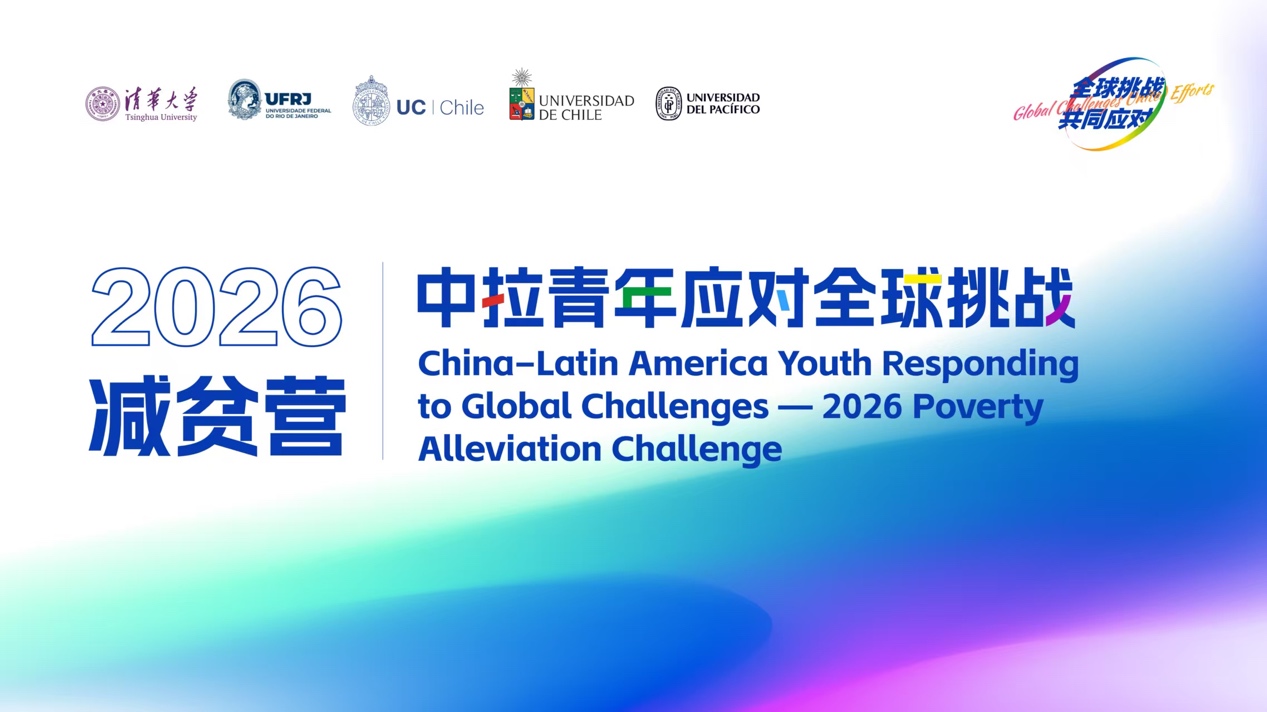
About the Poverty Alleviation Challenge Program
Poverty alleviation is a common challenge for developing countries and a shared challenge for the whole world. In 2024, the Tsinghua University Latin America Center, Research Center for China-Latin America Management Studies of Tsinghua School of Economics and Management (SEM), and Center for Global Competence Development at Tsinghua University, in collaboration with Latin American university partners, launched and carried out the "China-Latin America Youth Responding to Global Challenges — 2024 Poverty Alleviation Challenge Program" in China, Brazil, and Chile, sparking a wave of university-led poverty alleviation dialogues between China and Latin America. In November of the same year, during Chinese President Xi Jinping's state visit to Brazil to attend the G20 Summit, Tsinghua University and the Federal University of Rio de Janeiro signed a cooperation agreement for this project. The agreement was included in the list of visit outcomes, becoming a landmark project for win-win development between China and Latin America. On this basis, the "2025 Poverty Alleviation Challenge Program," jointly hosted by Tsinghua University and Latin American partner institutions, attracted over 310 teachers and students from 27 universities and enterprises across four countries in China and Latin America, with 12 teams advancing to the cross-national finals held in Chile and Brazil.
The "2026 Poverty Alleviation Challenge Program" will build upon the 2025 edition with greater innovation, injecting new momentum into the global poverty alleviation cause. Through cross-national teaming, competitions, and field research, it will gather the strength of Chinese and Latin American youth to jointly explore poverty alleviation solutions. Winning teams will also have the opportunity to travel to Latin America for study and exchange. If you are eager to inject new momentum into global poverty alleviation, now is the best time to set off.
Introduction
Globally, education has long been one of the most critical pathways to breaking the intergenerational transmission of poverty. However, in many developing countries, uneven educational resources, insufficient teacher capacity, and a lack of vocational skills continue to limit individual development and social progress. With the advancement of digital technology, a new question has emerged: Can digital education become a new tool for advancing poverty alleviation? Against this background, Tsinghua University Online Education Center presents four topics for the 2026 Poverty Alleviation Challenge, focusing on educational equity, skills development, and technological empowerment, inviting young people to propose innovative solutions.
Topic 1: Digital Teacher Growth Program – Enhancing Teaching Capacity for Rural Teachers
(Co-developed by Tsinghua University Online Education Center & Minera Las Bambas S.A.)
Teachers in many rural areas lack access to professional training and continuous development opportunities, with limited teaching resources and methods that affect student learning outcomes. This project aims to build a sustainable teacher professional development system by combining online courses and teacher communities.
Build an online professional development system for rural teachers, including:
· Online training courses
· A teaching case-sharing community
· Digital teaching tool training (e.g., smart classrooms)
Support: Minera Las Bambas S.A. will provide joint mentors and real application scenarios to support project implementation and practical landing. For mentor information, please refer to the official topic post of Minera Las Bambas S.A.
Topic 2: Online Vocational Skills Academy – Empowering Youth with Digital Economy Skills
In regions such as Latin America, millions of young people face:
· A lack of vocational skills training
· Barriers to entering the digital economy
· Unstable employment
This topic aims to build: A skills development system of “online courses + practical training + career matching” to equip youth with the skills needed for the digital economy and achieve stable income growth.
Course content includes:
· Digital marketing
· E-commerce operations
· Basic programming
· AI tool applications
Topic 3: Digital Agriculture Classroom – Improving Productivity for Smallholder Farmers
Agriculture is the foundation of many developing economies, yet smallholder farmers commonly face:
· Outdated technologies
· Limited market information
· Difficulties accessing high-value industrial chains
This topic proposes:
Build a mobile learning system for farmers, covering:
· Sustainable agricultural technologies
· Agricultural product processing and branding
· Agri-e-commerce sales
Through: “Online learning + offline guidance + production-marketing connection”to help farmers increase their earning capacity.
Topic 4: AI Study Partner – An Intelligent Learning Support System for Disadvantaged Students
In low-income areas, students often lack access to after-school tutoring, leaving learning difficulties unaddressed, which may lead to poor academic performance or even dropout. This topic proposes: Build an AI learning assistant for basic education students, supporting:
· Homework tutoring
· Concept explanation
· Personalized learning path recommendations
The goal is: To provide sustainable learning support in a low-cost, scalable way.
Insights from China’s Practice: How Digital Education Fights Poverty
Behind these topics lies China’s long-term exploration in digital education:
Teacher Capacity Building – Building a Sustainable Development System
· Covers 24 provinces across China
· Serves over 5,000 frontline teachers each semester, nearly 30,000 in total
· Provides lesson observation, teaching seminars, AI-assisted teaching, and more�� Forms a teacher growth model: “Real Classroom + Online Observation + Teacher Community”
Educational Resource Sharing – Breaking Regional Barriers
· High-quality courses shared from eastern universities to western regions
· “One Class Together” via live classrooms
· Collaborative lesson planning and joint teaching
· Enables students to access high-quality educational resources across regions
Practical Insights
· Digital education enables scalable sharing of high-quality resources
· More importantly, it systematically improves teacher capacity
· Shifting from “knowledge delivery” to “capacity building + system construction”
Project Mentor

Li Hongru
Director, Tsinghua University Online Education Center
Assistant Secretary-General, the World MOOC and Online Education Alliance
She has long been committed to advancing the digital transformation of higher education and international cooperation, with extensive experience in online education and AI-enabled education. Her work focuses on expanding partnerships with global universities and educational institutions, promoting MOOC development and collaboration, smart teaching tools, and the construction of digital learning ecosystems.
Closing
Education transforms lives,
technology amplifies potential.
If you are passionate about digital education,
this challenge is made for you.
When digital education meets global poverty alleviation,
the answer for the next step may lie in your hands.
Join the 2026 China-Latin America Youth Poverty Alleviation Challenge
Use your solutions to address real-world challenges